


February 2026 Poll Results
In February, the SLU/YouGov Poll surveyed 900 likely Missouri voters to assess their opinions concerning U.S. and Missouri political actors, abortion, gender affirming care, taxes, and more.
- February 2026 SLU/YouGov Poll Press Release
- February 2026 SLU/YouGov Poll Top Line Results
- February 2026 SLU/YouGov Poll Results with Demographic and Party Cross Tabs
Analyses of February 2026 Poll from SLU/YouGov Poll Team
- A Majority of Voters Support an A-F Grading Scale for Missouri Schools by Abigail Medler, M.P.A.
- How Missouri’s Likely Voters View The Economy, Sales Taxes, and Redistricting by Kenneth Warren, Ph.D.
- Missouri Constitutional Amendment on Abortion; Data Centers; and Death Penalty by Kenneth Warren, Ph.D.
- Once Again, Missouri’s Likely Voters Give Positive Ratings to Missouri’s Top Politicians by Kenneth Warren, Ph.D.
The SLU/YouGov Poll brings national attention to Missouri politics, receiving coverage from The Washington Post, Politico, and MSNBC, amongst other outlets. To get the latest updates, follow the SLU Poll team on X, previously Twitter.
SLU/YouGov Polling Funding and Partners
Approval Ratings of National and State Political Actors
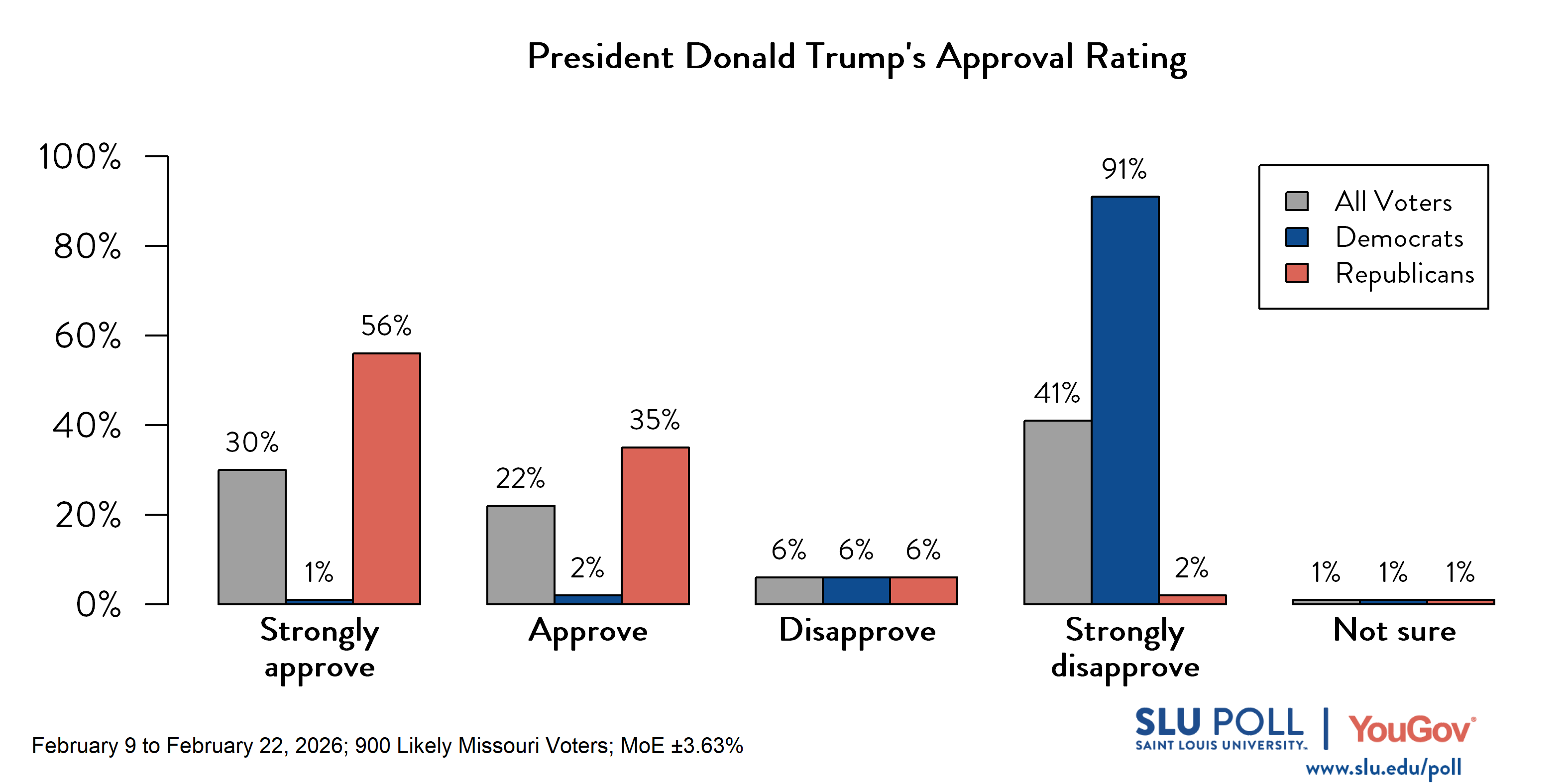
Likely voters' responses to 'Do you approve or disapprove of the way each is doing their job...Donald Trump?': 30% Strongly approve, 22% Approve, 6% Disapprove, 41% Strongly disapprove, and 1% Not sure. Democratic voters' responses: 1% Strongly approve, 2% Approve, 6% Disapprove, 91% Strongly disapprove, and 1% Not sure. Republican voters' responses: 56% Strongly approve, 35% Approve, 6% Disapprove, 2% Strongly disapprove, and 1% Not sure.
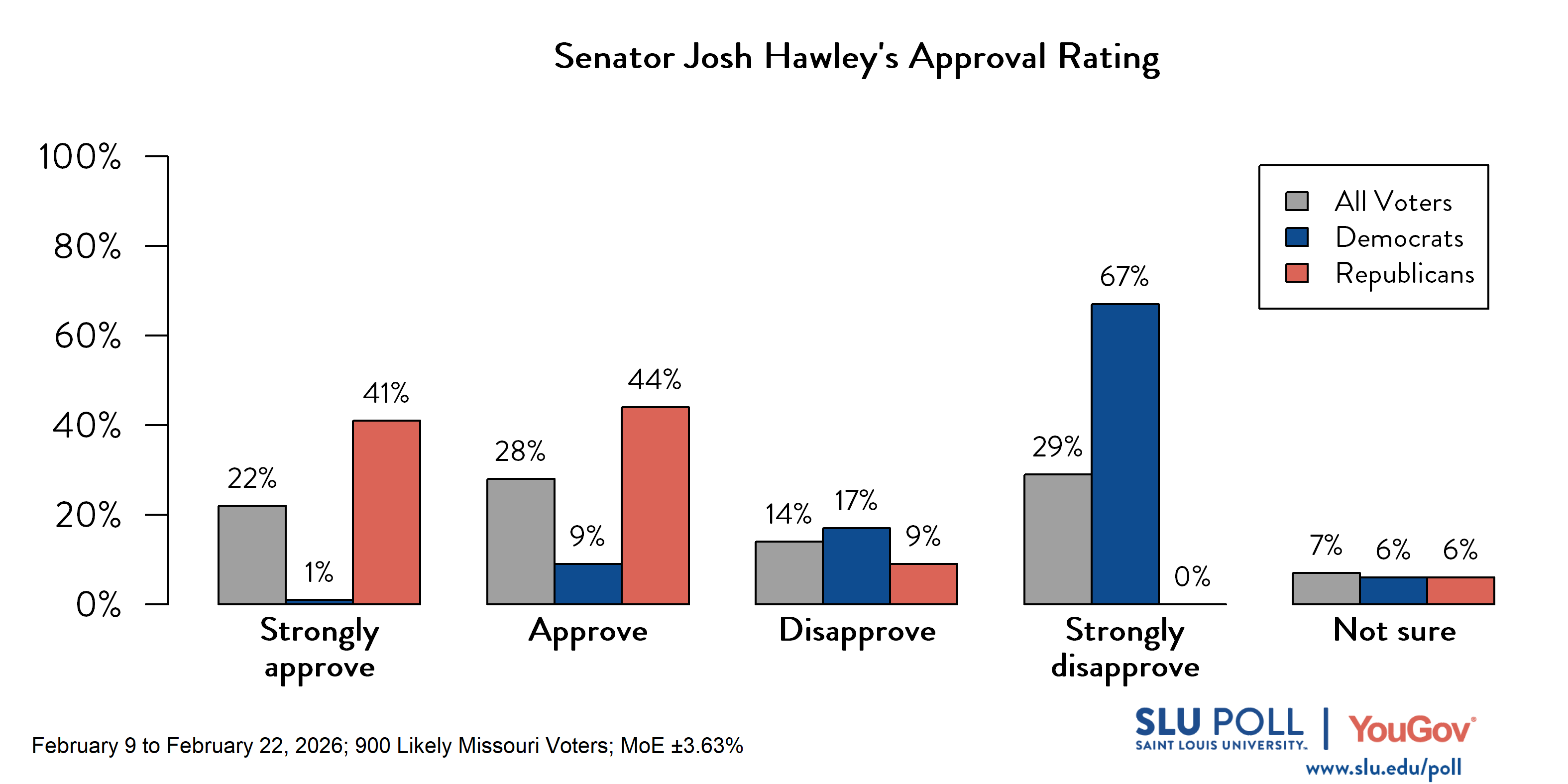 Likely voters' responses to 'Do you approve or disapprove of the way each is doing
their job...Senator Josh Hawley?': 22% Strongly approve, 28% Approve, 14% Disapprove,
29% Strongly disapprove, and 7% Not sure. Democratic voters' responses: 1% Strongly
approve, 9% Approve, 17% Disapprove, 67% Strongly disapprove, and 6% Not sure. Republican
voters' responses: 41% Strongly approve, 44% Approve, 9% Disapprove, 0% Strongly disapprove,
and 6% Not sure.
Likely voters' responses to 'Do you approve or disapprove of the way each is doing
their job...Senator Josh Hawley?': 22% Strongly approve, 28% Approve, 14% Disapprove,
29% Strongly disapprove, and 7% Not sure. Democratic voters' responses: 1% Strongly
approve, 9% Approve, 17% Disapprove, 67% Strongly disapprove, and 6% Not sure. Republican
voters' responses: 41% Strongly approve, 44% Approve, 9% Disapprove, 0% Strongly disapprove,
and 6% Not sure. 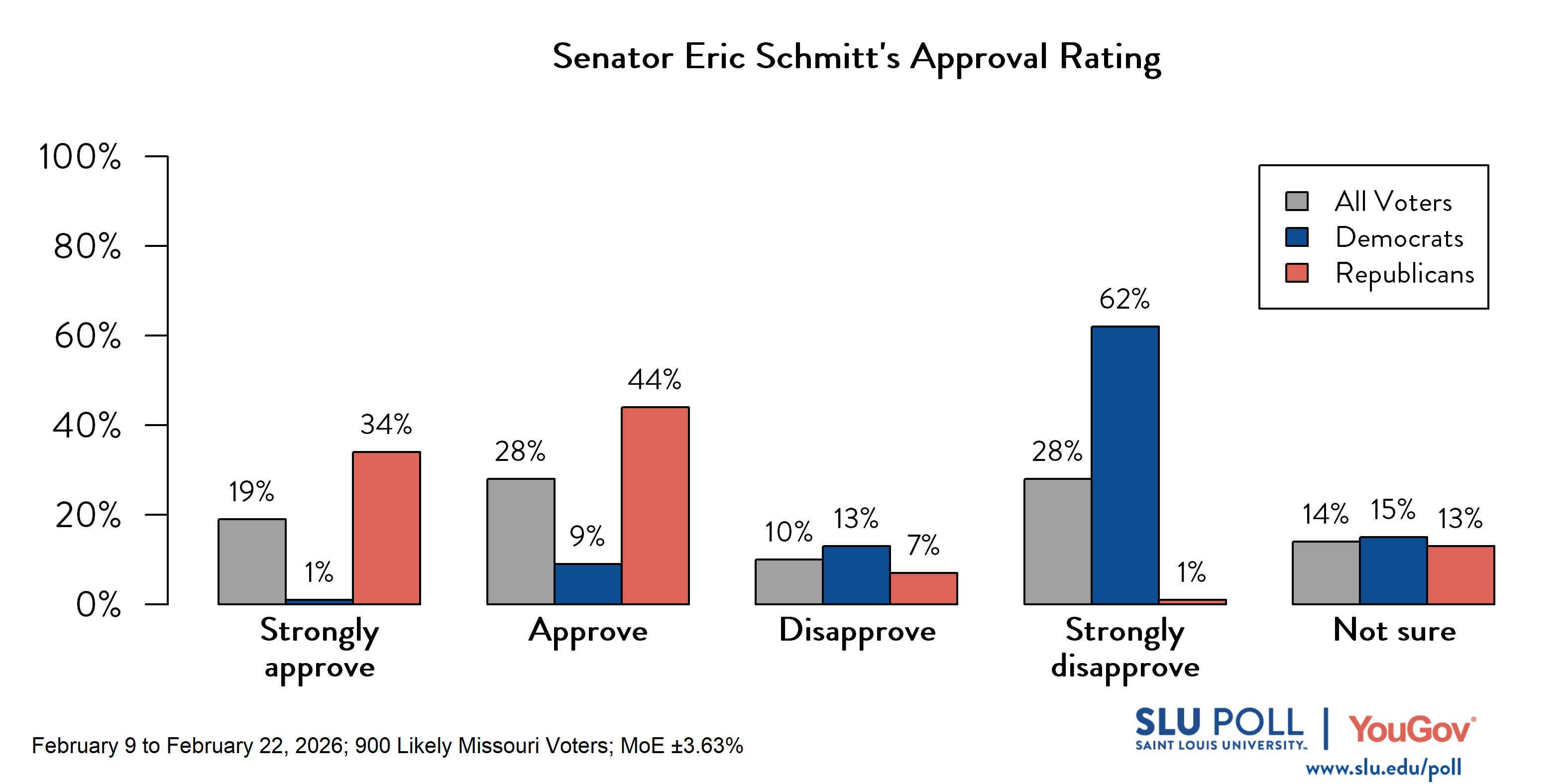 Likely voters' responses to 'Do you approve or disapprove of the way each is doing
their job...Senator Eric Schmitt?': 19% Strongly approve, 28% Approve, 10% Disapprove,
28% Strongly disapprove, and 14% Not sure. Democratic voters' responses: 1% Strongly
approve, 9% Approve, 13% Disapprove, 62% Strongly disapprove, and 15% Not sure. Republican
voters' responses: 34% Strongly approve, 44% Approve, 7% Disapprove, 1% Strongly disapprove,
and 13% Not sure.
Likely voters' responses to 'Do you approve or disapprove of the way each is doing
their job...Senator Eric Schmitt?': 19% Strongly approve, 28% Approve, 10% Disapprove,
28% Strongly disapprove, and 14% Not sure. Democratic voters' responses: 1% Strongly
approve, 9% Approve, 13% Disapprove, 62% Strongly disapprove, and 15% Not sure. Republican
voters' responses: 34% Strongly approve, 44% Approve, 7% Disapprove, 1% Strongly disapprove,
and 13% Not sure. 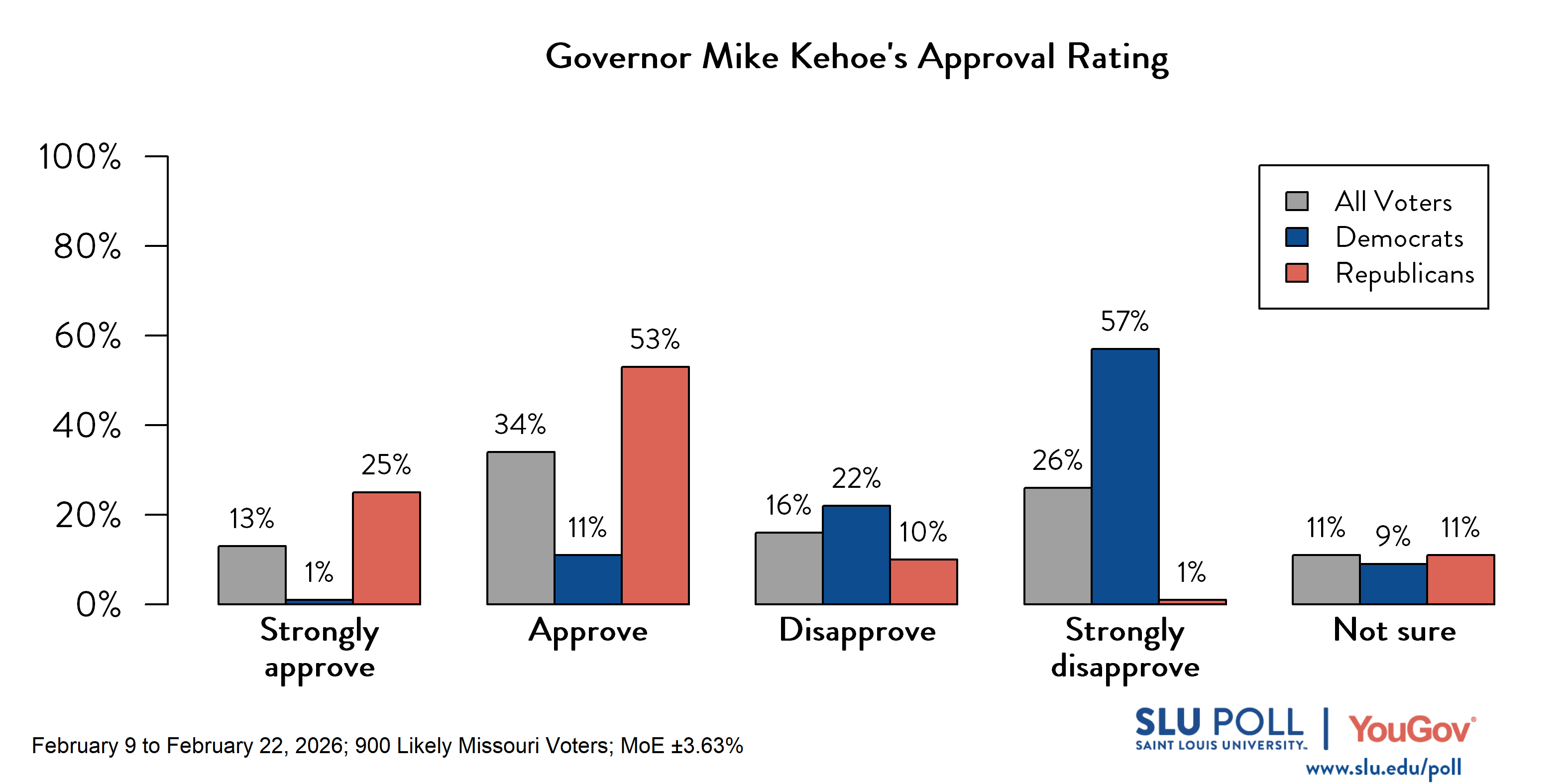 Likely voters' responses to 'Do you approve or disapprove of the way each is doing
their job...Governor Mike Kehoe?': 13% Strongly approve, 34% Approve, 16% Disapprove,
26% Strongly disapprove, and 11% Not sure. Democratic voters' responses: 1% Strongly
approve, 11% Approve, 22% Disapprove, 57% Strongly disapprove, and 9% Not sure. Republican
voters' responses: 25% Strongly approve, 53% Approve, 10% Disapprove, 1% Strongly
disapprove, and 11% Not sure.
Likely voters' responses to 'Do you approve or disapprove of the way each is doing
their job...Governor Mike Kehoe?': 13% Strongly approve, 34% Approve, 16% Disapprove,
26% Strongly disapprove, and 11% Not sure. Democratic voters' responses: 1% Strongly
approve, 11% Approve, 22% Disapprove, 57% Strongly disapprove, and 9% Not sure. Republican
voters' responses: 25% Strongly approve, 53% Approve, 10% Disapprove, 1% Strongly
disapprove, and 11% Not sure. 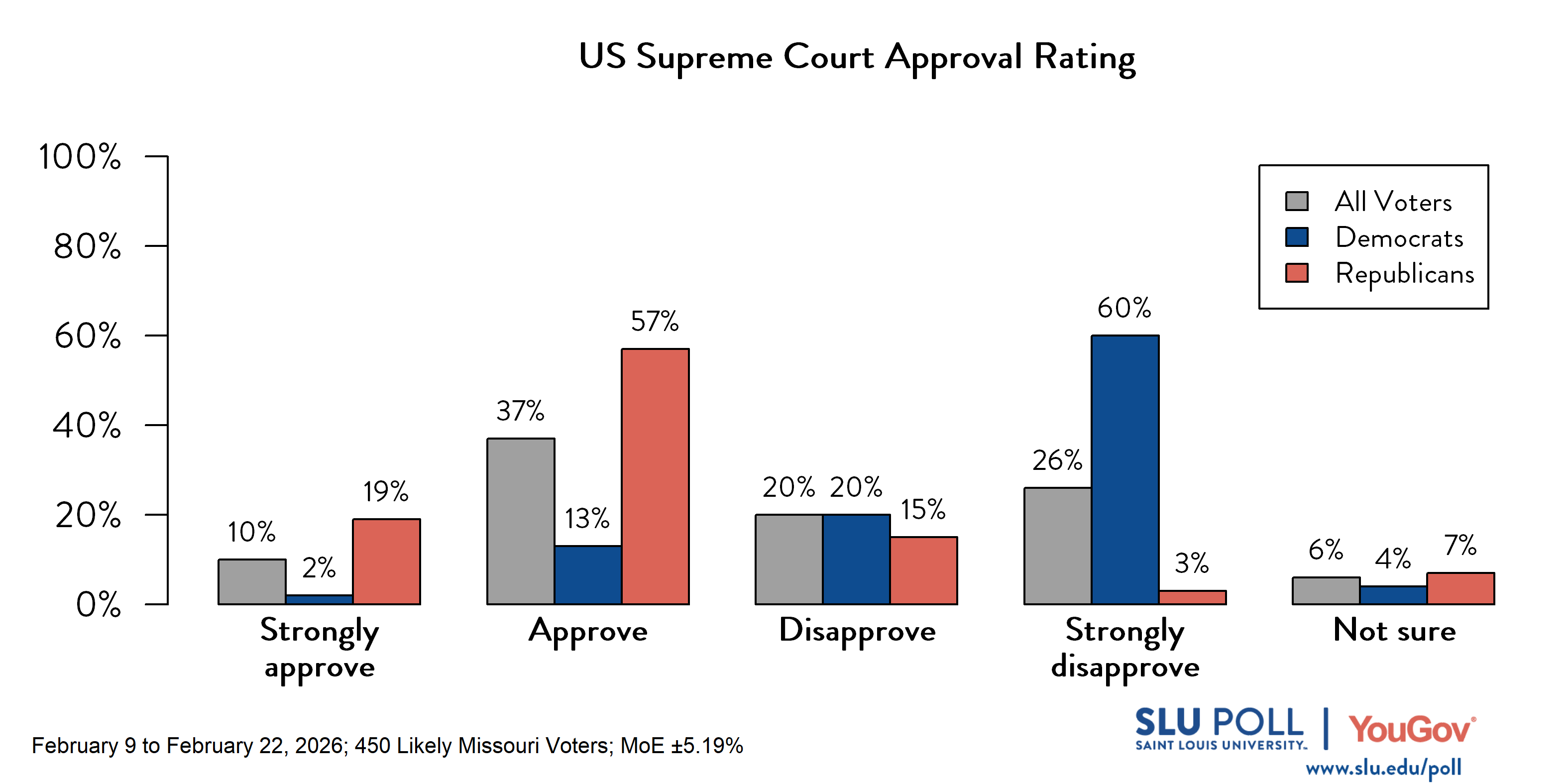 Likely voters' responses to 'Do you approve or disapprove of the way each is doing
their job...The U.S. Supreme Court?': 10% Strongly approve, 37% Approve, 20% Disapprove,
26% Strongly disapprove, and 6% Not sure. Democratic voters' responses: 2% Strongly
approve, 13% Approve, 20% Disapprove, 60% Strongly disapprove, and 4% Not sure. Republican
voters' responses: 19% Strongly approve, 57% Approve, 15% Disapprove, 3% Strongly
disapprove, and 7% Not sure.
Likely voters' responses to 'Do you approve or disapprove of the way each is doing
their job...The U.S. Supreme Court?': 10% Strongly approve, 37% Approve, 20% Disapprove,
26% Strongly disapprove, and 6% Not sure. Democratic voters' responses: 2% Strongly
approve, 13% Approve, 20% Disapprove, 60% Strongly disapprove, and 4% Not sure. Republican
voters' responses: 19% Strongly approve, 57% Approve, 15% Disapprove, 3% Strongly
disapprove, and 7% Not sure. 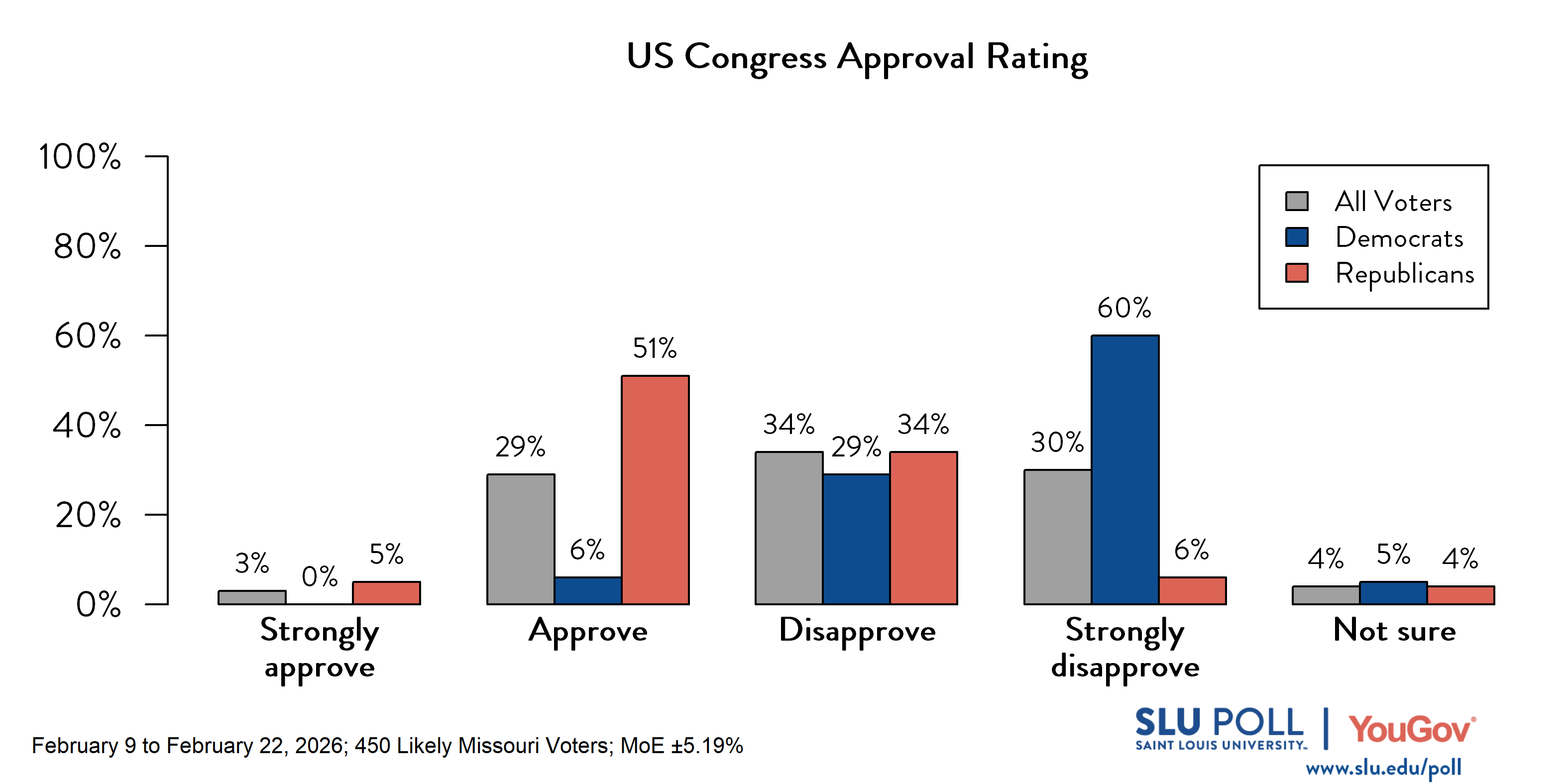 Likely voters' responses to 'Do you approve or disapprove of the way each is doing
their job...The U.S. Congress?': 3% Strongly approve, 29% Approve, 34% Disapprove,
30% Strongly disapprove, and 4% Not sure. Democratic voters' responses: 0% Strongly
approve, 6% Approve, 29% Disapprove, 60% Strongly disapprove, and 5% Not sure. Republican
voters' responses: 5% Strongly approve, 51% Approve, 34% Disapprove, 6% Strongly disapprove,
and 4% Not sure.
Likely voters' responses to 'Do you approve or disapprove of the way each is doing
their job...The U.S. Congress?': 3% Strongly approve, 29% Approve, 34% Disapprove,
30% Strongly disapprove, and 4% Not sure. Democratic voters' responses: 0% Strongly
approve, 6% Approve, 29% Disapprove, 60% Strongly disapprove, and 5% Not sure. Republican
voters' responses: 5% Strongly approve, 51% Approve, 34% Disapprove, 6% Strongly disapprove,
and 4% Not sure. 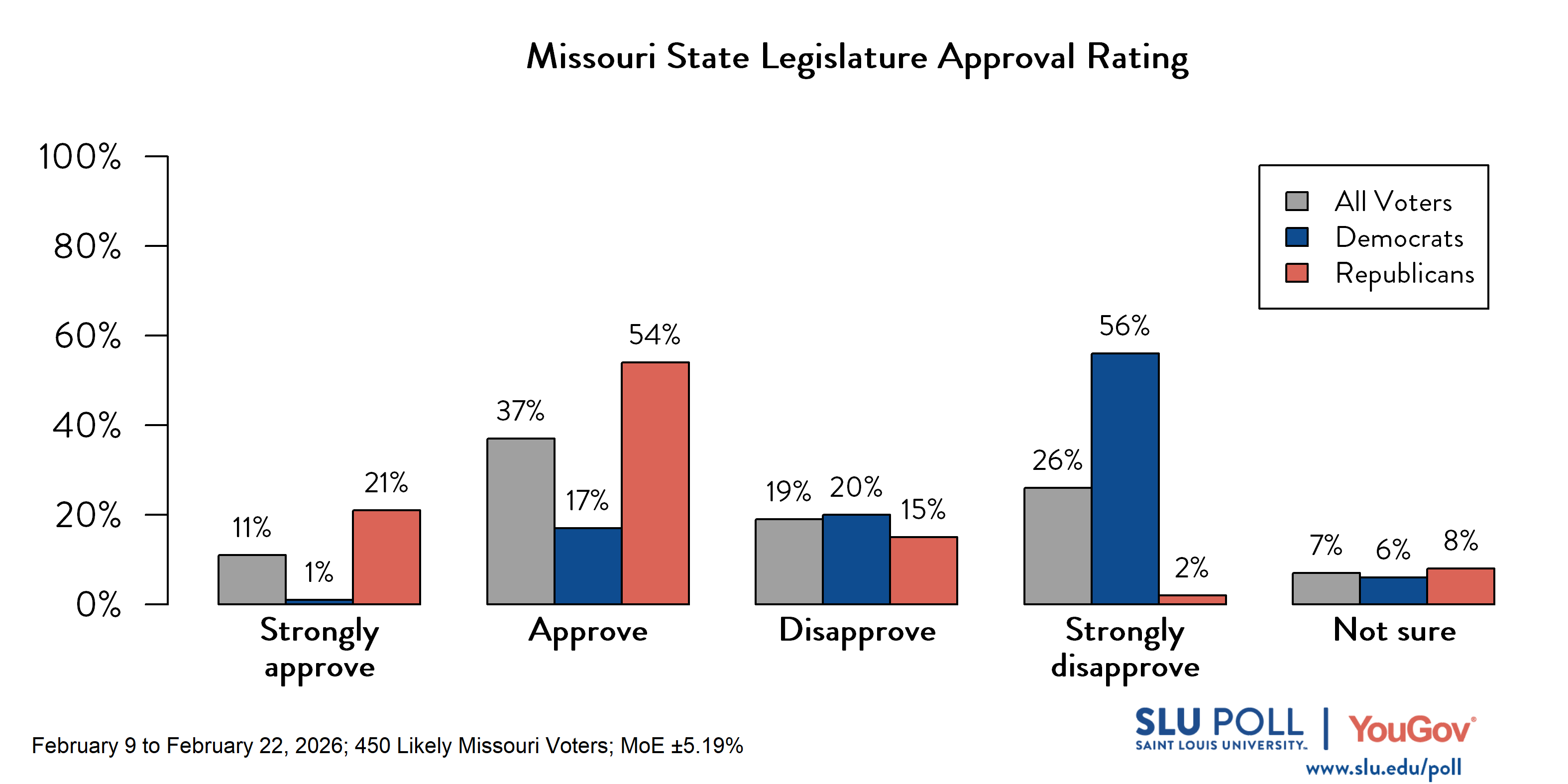 Likely voters' responses to 'Do you approve or disapprove of the way each is doing
their job...The Missouri State Legislature?': 11% Strongly approve, 37% Approve, 19%
Disapprove, 26% Strongly disapprove, and 7% Not sure. Democratic voters' responses:
1% Strongly approve, 17% Approve, 20% Disapprove, 56% Strongly disapprove, and 6%
Not sure. Republican voters' responses: 21% Strongly approve, 54% Approve, 15% Disapprove,
2% Strongly disapprove, and 8% Not sure.
Likely voters' responses to 'Do you approve or disapprove of the way each is doing
their job...The Missouri State Legislature?': 11% Strongly approve, 37% Approve, 19%
Disapprove, 26% Strongly disapprove, and 7% Not sure. Democratic voters' responses:
1% Strongly approve, 17% Approve, 20% Disapprove, 56% Strongly disapprove, and 6%
Not sure. Republican voters' responses: 21% Strongly approve, 54% Approve, 15% Disapprove,
2% Strongly disapprove, and 8% Not sure.Congressional Elections
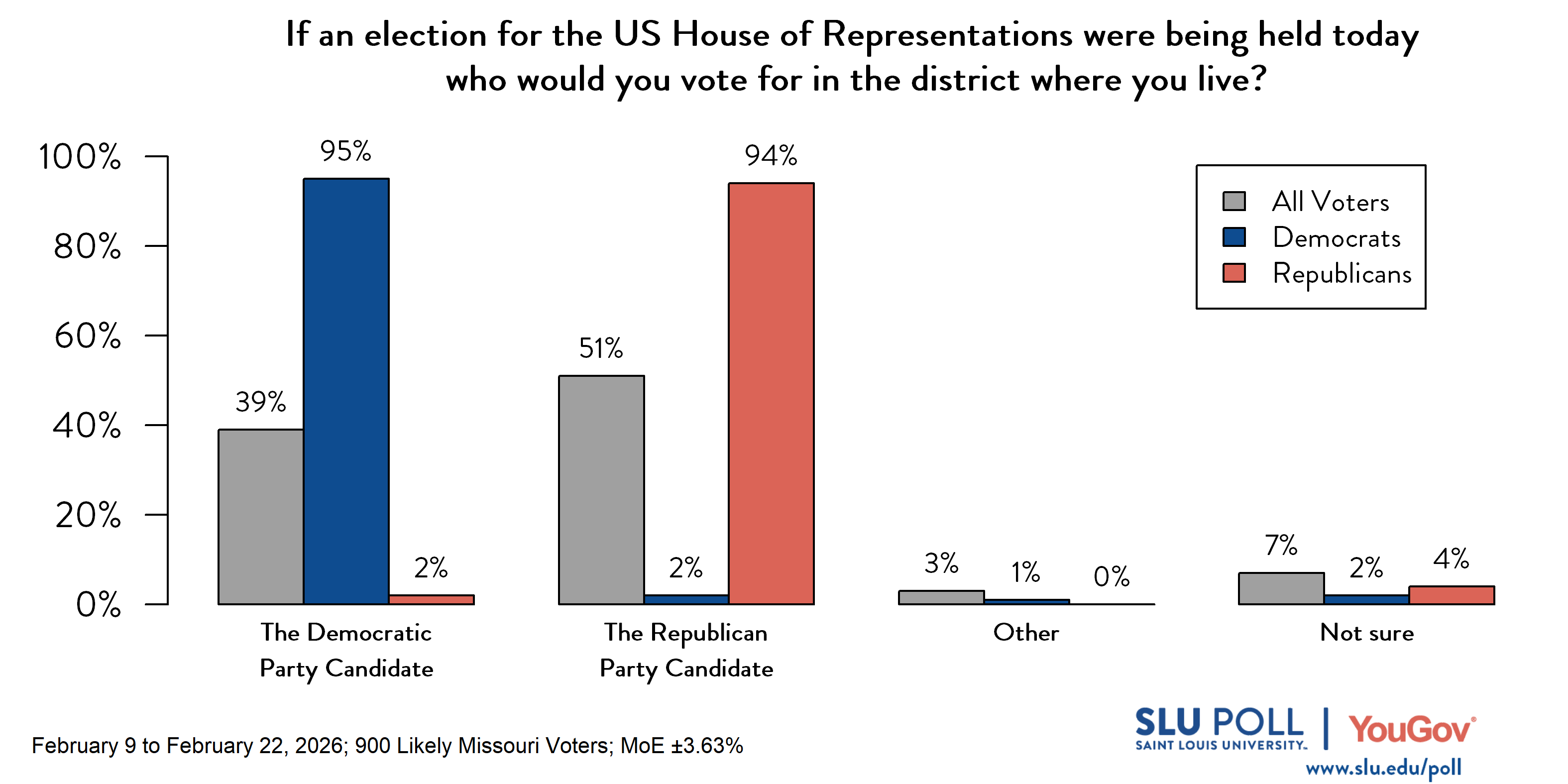 Likely voters' responses to 'If an election for the US House of Representatives were
being held today, who would you vote for in the district where you live?': 39% The
Democratic Party candidate, 51% The Republican Party candidate, 3% Other, and 7% Not
sure. Democratic voters' responses: 95% The Democratic Party candidate, 2% The Republican
Party candidate, 1% Other, and 2% Not sure. Republican voters' responses: 2% The Democratic
Party candidate, 94% The Republican Party candidate, 0% Other, and 4% Not sure.
Likely voters' responses to 'If an election for the US House of Representatives were
being held today, who would you vote for in the district where you live?': 39% The
Democratic Party candidate, 51% The Republican Party candidate, 3% Other, and 7% Not
sure. Democratic voters' responses: 95% The Democratic Party candidate, 2% The Republican
Party candidate, 1% Other, and 2% Not sure. Republican voters' responses: 2% The Democratic
Party candidate, 94% The Republican Party candidate, 0% Other, and 4% Not sure. 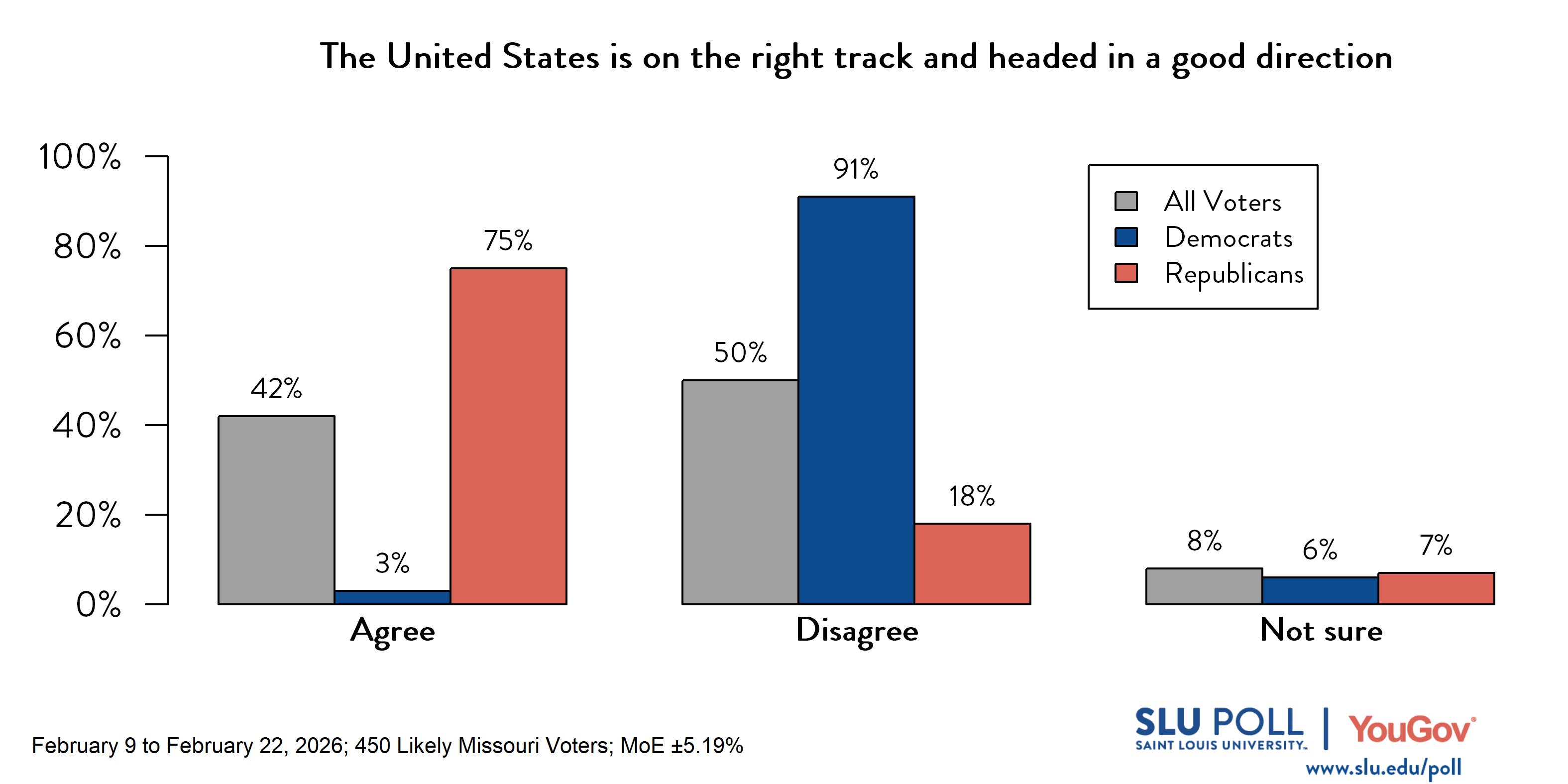 Likely voters' responses to 'Do you agree or disagree with the following statements...The
United States is on the right track and headed in a good direction?': 42% Agree, 50%
Disagree, and 8% Not sure. Democratic voters' responses: 3% Agree, 91% Disagree, and
6% Not sure. Republican voters' responses: 75% Agree, 18% Disagree, and 7% Not sure.
Likely voters' responses to 'Do you agree or disagree with the following statements...The
United States is on the right track and headed in a good direction?': 42% Agree, 50%
Disagree, and 8% Not sure. Democratic voters' responses: 3% Agree, 91% Disagree, and
6% Not sure. Republican voters' responses: 75% Agree, 18% Disagree, and 7% Not sure.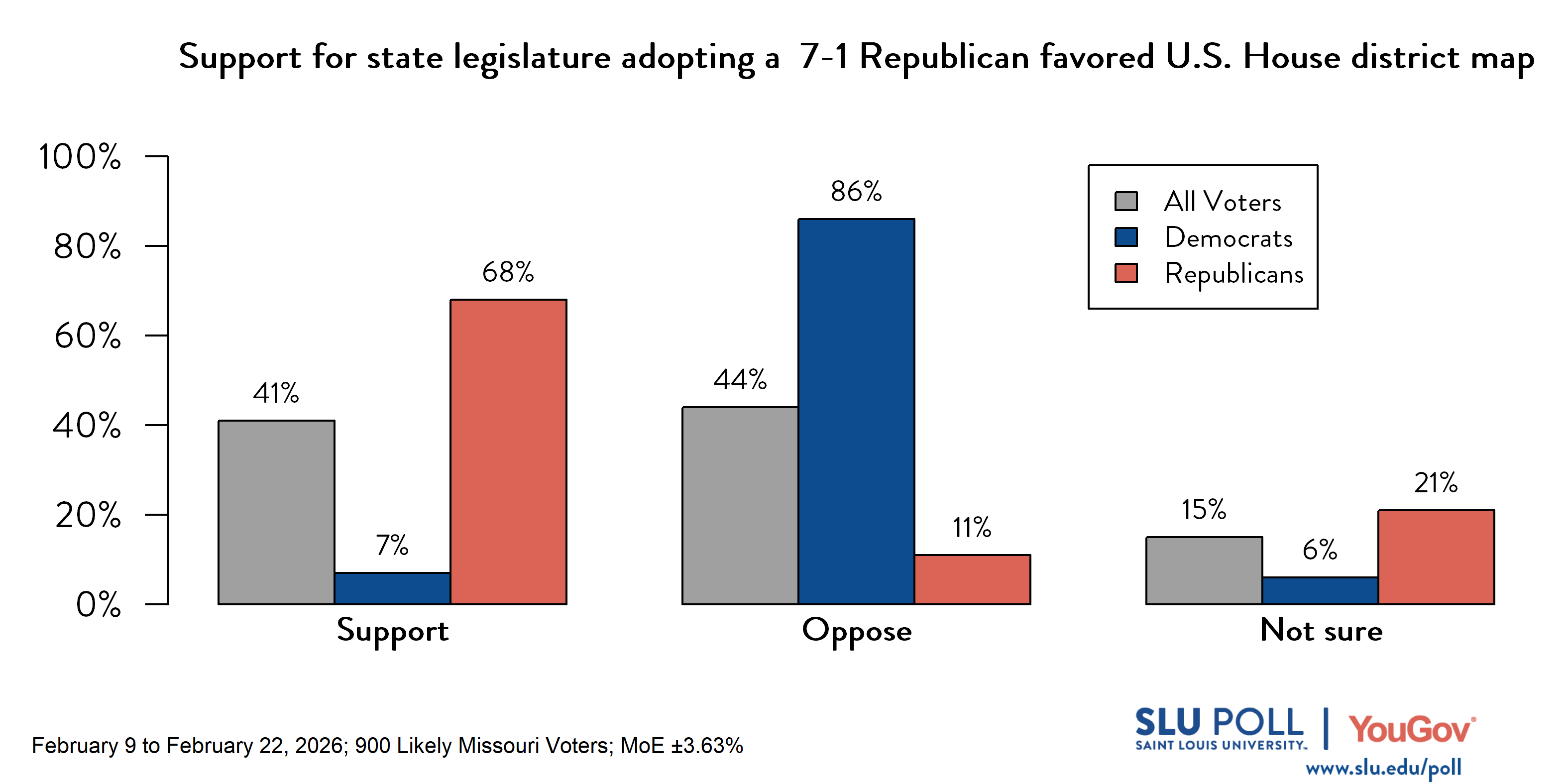 Likely voters' responses to 'Following the 2020 census, the Missouri state legislature
passed a bill in 2022 adopting new congressional district maps. In elections held
using those maps, Republicans won six seats and Democrats won two seats in Missouri's
US House delegation. Last year, the Missouri state legislature passed a new bill adopting
new congressional district maps, with the hope that Republicans would win seven seats
and Democrats would win one seat...Do you support or oppose the state legislature
adopting this new map of congressional districts?': 41% Support, 44% Oppose, and 15%
Not sure. Democratic voters' responses: 7% Support, 86% Oppose, and 6% Not sure. Republican
voters' responses: 68% Support, 11% Oppose, and 21% Not sure.
Likely voters' responses to 'Following the 2020 census, the Missouri state legislature
passed a bill in 2022 adopting new congressional district maps. In elections held
using those maps, Republicans won six seats and Democrats won two seats in Missouri's
US House delegation. Last year, the Missouri state legislature passed a new bill adopting
new congressional district maps, with the hope that Republicans would win seven seats
and Democrats would win one seat...Do you support or oppose the state legislature
adopting this new map of congressional districts?': 41% Support, 44% Oppose, and 15%
Not sure. Democratic voters' responses: 7% Support, 86% Oppose, and 6% Not sure. Republican
voters' responses: 68% Support, 11% Oppose, and 21% Not sure.Abortion and Gender Affirming Care
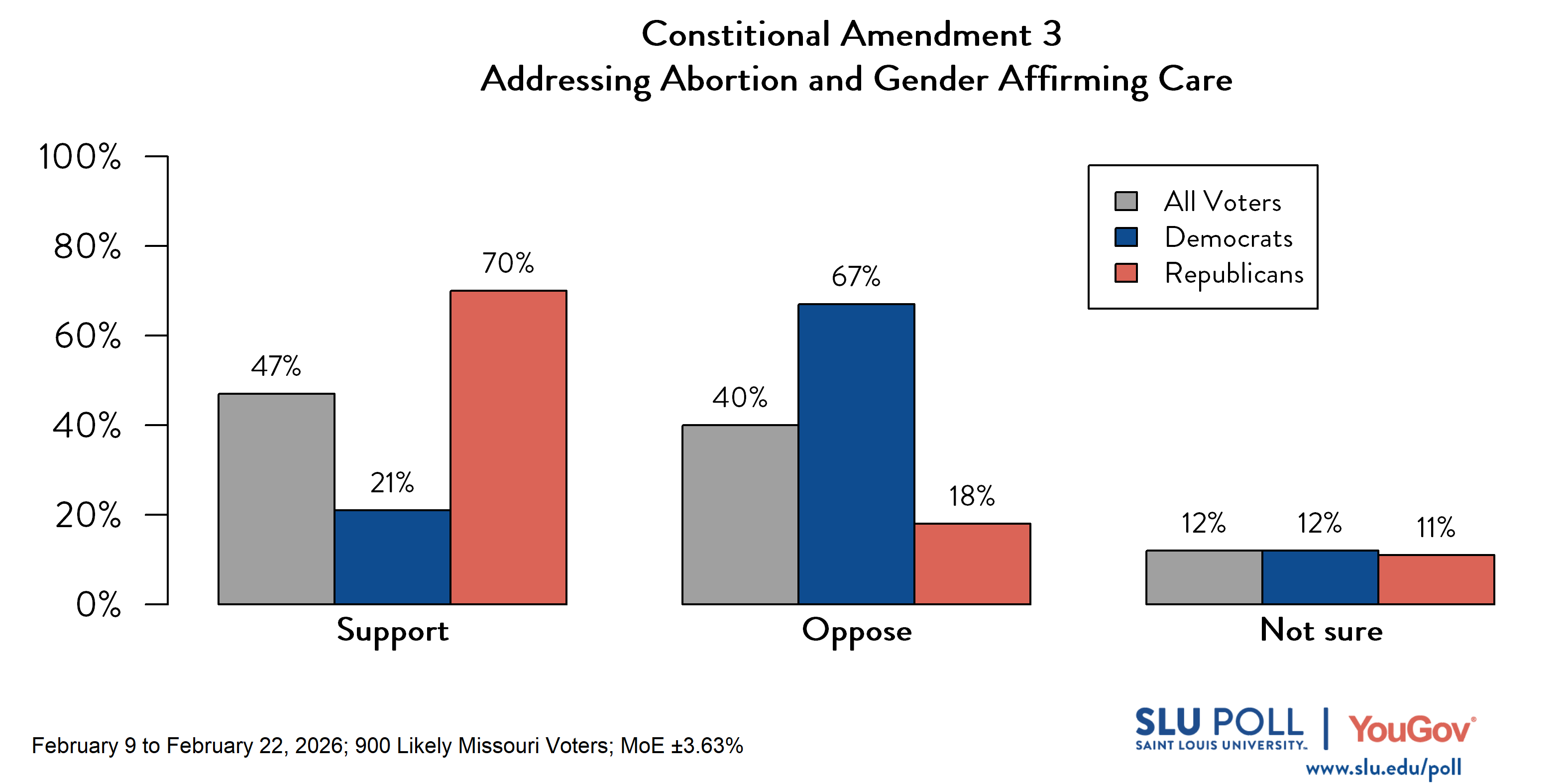 Likely voters' responses to 'In an upcoming election, Missouri voters may be asked
to amend the state constitution to address the issue of health care. Respondents saw
Ballot Proposition Language Amendment 3...If this proposal appeared on the ballot,
would you support or oppose it?': 47% Support, 40% Oppose, and 12% Not sure. Democratic
voters' responses: 21% Support, 67% Oppose, and 12% Not sure. Republican voters' responses:
70% Support, 18% Oppose, and 11% Not sure.
Likely voters' responses to 'In an upcoming election, Missouri voters may be asked
to amend the state constitution to address the issue of health care. Respondents saw
Ballot Proposition Language Amendment 3...If this proposal appeared on the ballot,
would you support or oppose it?': 47% Support, 40% Oppose, and 12% Not sure. Democratic
voters' responses: 21% Support, 67% Oppose, and 12% Not sure. Republican voters' responses:
70% Support, 18% Oppose, and 11% Not sure.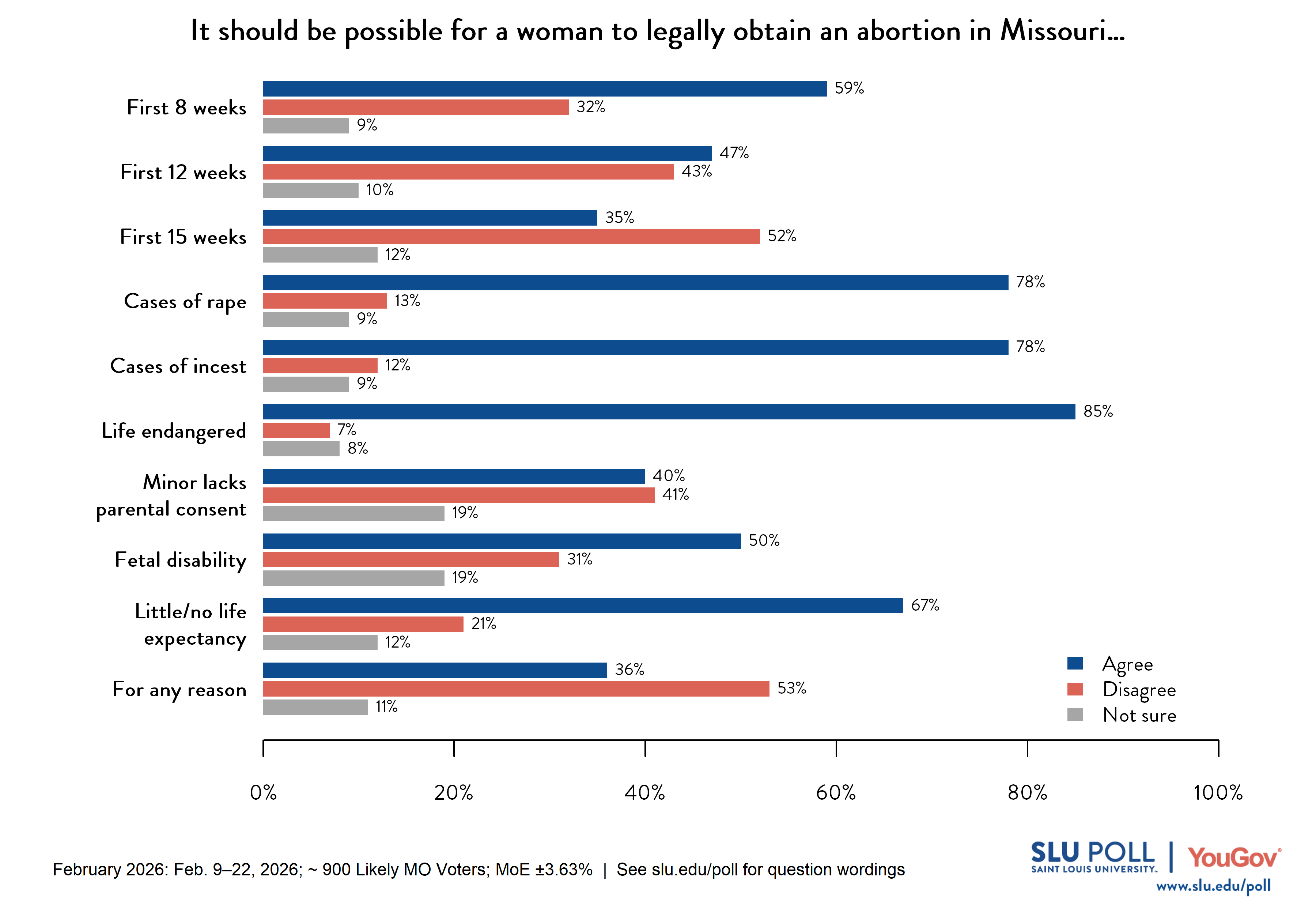 This graph presents likely voters' responses to ten questions about whether it should
be possible for a woman to legally obtain an abortion in Missouri under various circumstances.
Support is highest for medically urgent or non-consensual situations: 85% of likely
voters agree abortion should be possible when a woman's life is endangered (7% disagree,
8% not sure), 78% agree in cases of rape (13% disagree, 9% not sure), and 78% agree
in cases of incest (12% disagree, 9% not sure). Support is also majority in favor
when there is little or no life expectancy for the baby, at 67% (21% disagree, 12%
not sure), and in the first eight weeks of pregnancy, at 59% (32% disagree, 9% not
sure). For fetal disability, voters are evenly divided, with 50% agreeing (31% disagree,
19% not sure). Support falls below a majority for abortion in the first 12 weeks at
47% (43% disagree, 10% not sure), when a minor lacks parental consent at 40% (41%
disagree, 19% not sure), for any reason at 36% (53% disagree, 11% not sure), and in
the first 15 weeks at 35% (52% disagree, 12% not sure).
This graph presents likely voters' responses to ten questions about whether it should
be possible for a woman to legally obtain an abortion in Missouri under various circumstances.
Support is highest for medically urgent or non-consensual situations: 85% of likely
voters agree abortion should be possible when a woman's life is endangered (7% disagree,
8% not sure), 78% agree in cases of rape (13% disagree, 9% not sure), and 78% agree
in cases of incest (12% disagree, 9% not sure). Support is also majority in favor
when there is little or no life expectancy for the baby, at 67% (21% disagree, 12%
not sure), and in the first eight weeks of pregnancy, at 59% (32% disagree, 9% not
sure). For fetal disability, voters are evenly divided, with 50% agreeing (31% disagree,
19% not sure). Support falls below a majority for abortion in the first 12 weeks at
47% (43% disagree, 10% not sure), when a minor lacks parental consent at 40% (41%
disagree, 19% not sure), for any reason at 36% (53% disagree, 11% not sure), and in
the first 15 weeks at 35% (52% disagree, 12% not sure).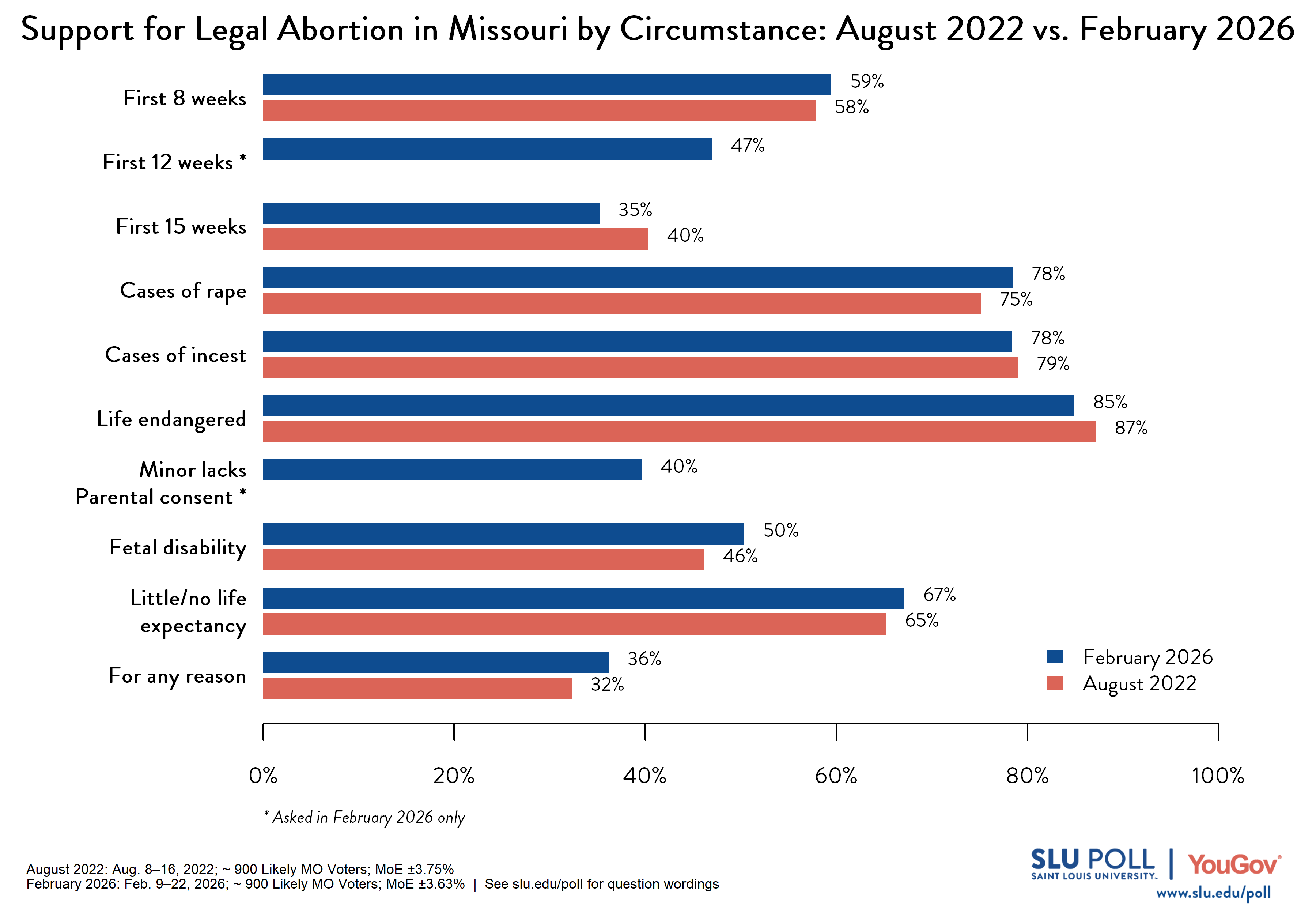 This graph compares likely voters' support for legal abortion in Missouri across ten
circumstances between August 2022 and February 2026. Two circumstances - first 12
weeks of pregnancy and when a minor lacks parental consent - were asked only in February
2026, with 47% and 40% support respectively. For the eight circumstances asked in
both polls, support levels are largely stable over time. Support for abortion when
a woman's life is endangered remained high in both years (87% in 2022, 85% in 2026),
as did support in cases of rape (75% in 2022, 78% in 2026) and cases of incest (79%
in 2022, 78% in 2026). Support also held steady for little or no life expectancy for
the baby (65% in 2022, 67% in 2026), fetal disability (46% in 2022, 50% in 2026),
and in the first eight weeks of pregnancy (58% in 2022, 59% in 2026). The largest
shifts were for abortion in the first 15 weeks, where support declined from 40% in
2022 to 35% in 2026, and for any reason, where support increased slightly from 32%
in 2022 to 36% in 2026.
This graph compares likely voters' support for legal abortion in Missouri across ten
circumstances between August 2022 and February 2026. Two circumstances - first 12
weeks of pregnancy and when a minor lacks parental consent - were asked only in February
2026, with 47% and 40% support respectively. For the eight circumstances asked in
both polls, support levels are largely stable over time. Support for abortion when
a woman's life is endangered remained high in both years (87% in 2022, 85% in 2026),
as did support in cases of rape (75% in 2022, 78% in 2026) and cases of incest (79%
in 2022, 78% in 2026). Support also held steady for little or no life expectancy for
the baby (65% in 2022, 67% in 2026), fetal disability (46% in 2022, 50% in 2026),
and in the first eight weeks of pregnancy (58% in 2022, 59% in 2026). The largest
shifts were for abortion in the first 15 weeks, where support declined from 40% in
2022 to 35% in 2026, and for any reason, where support increased slightly from 32%
in 2022 to 36% in 2026.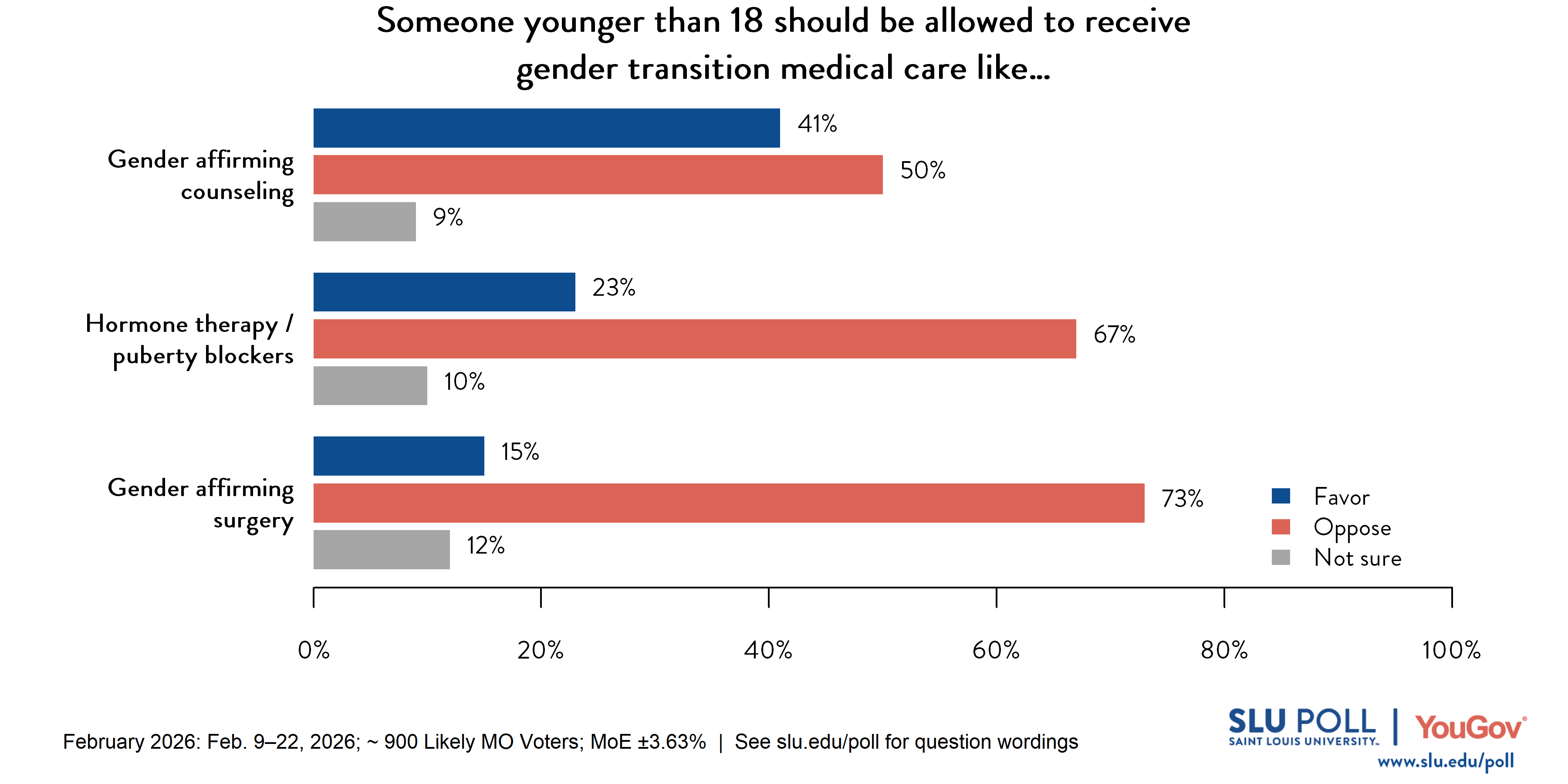 This graph presents likely voters' responses to three questions about whether someone
younger than 18 should be allowed to receive gender transition medical care. For gender
affirming counseling, 41% of likely voters favor allowing it, 50% oppose, and 9% are
not sure. For hormone therapy or medication that can temporarily prevent the effects
of puberty, 23% favor, 67% oppose, and 10% are not sure. For gender affirming surgery,
15% favor, 73% oppose, and 12% are not sure.
This graph presents likely voters' responses to three questions about whether someone
younger than 18 should be allowed to receive gender transition medical care. For gender
affirming counseling, 41% of likely voters favor allowing it, 50% oppose, and 9% are
not sure. For hormone therapy or medication that can temporarily prevent the effects
of puberty, 23% favor, 67% oppose, and 10% are not sure. For gender affirming surgery,
15% favor, 73% oppose, and 12% are not sure. 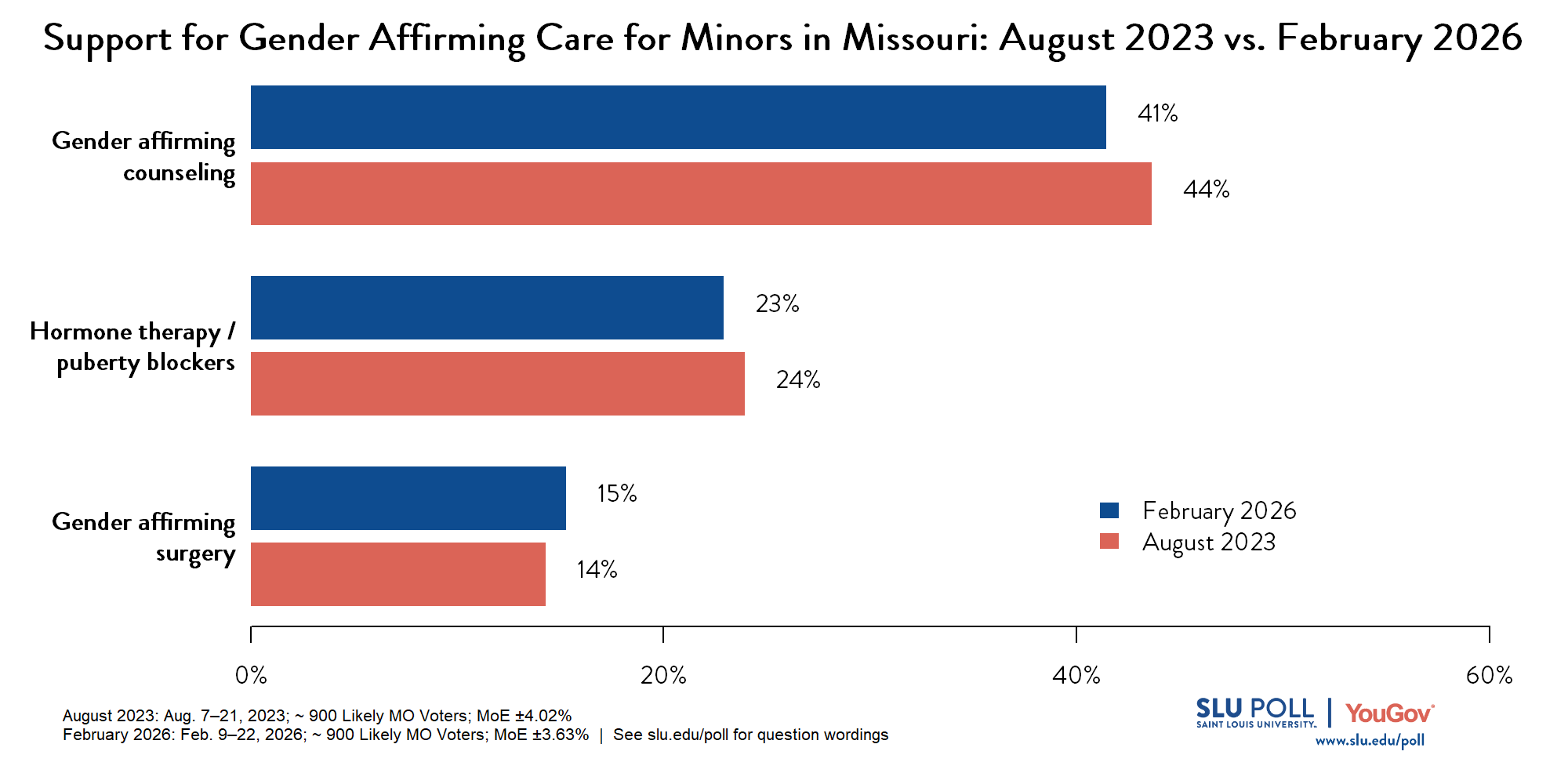 This graph compares likely voters' support for allowing someone younger than 18 to
receive gender transition medical care across three types of care between August 2023
and February 2026. Support levels are remarkably stable across both polls. For gender
affirming counseling, 44% of likely voters were in favor in August 2023, compared
to 41% in February 2026. For hormone therapy or puberty blockers, support was 24%
in August 2023 and 23% in February 2026. For gender affirming surgery, support was
14% in August 2023 and 15% in February 2026. Across all three types of care, the changes
between 2023 and 2026 are within the margin of error, suggesting that likely Missouri
voters' views on gender affirming care for minors have remained largely unchanged
over this period.
This graph compares likely voters' support for allowing someone younger than 18 to
receive gender transition medical care across three types of care between August 2023
and February 2026. Support levels are remarkably stable across both polls. For gender
affirming counseling, 44% of likely voters were in favor in August 2023, compared
to 41% in February 2026. For hormone therapy or puberty blockers, support was 24%
in August 2023 and 23% in February 2026. For gender affirming surgery, support was
14% in August 2023 and 15% in February 2026. Across all three types of care, the changes
between 2023 and 2026 are within the margin of error, suggesting that likely Missouri
voters' views on gender affirming care for minors have remained largely unchanged
over this period.Taxes
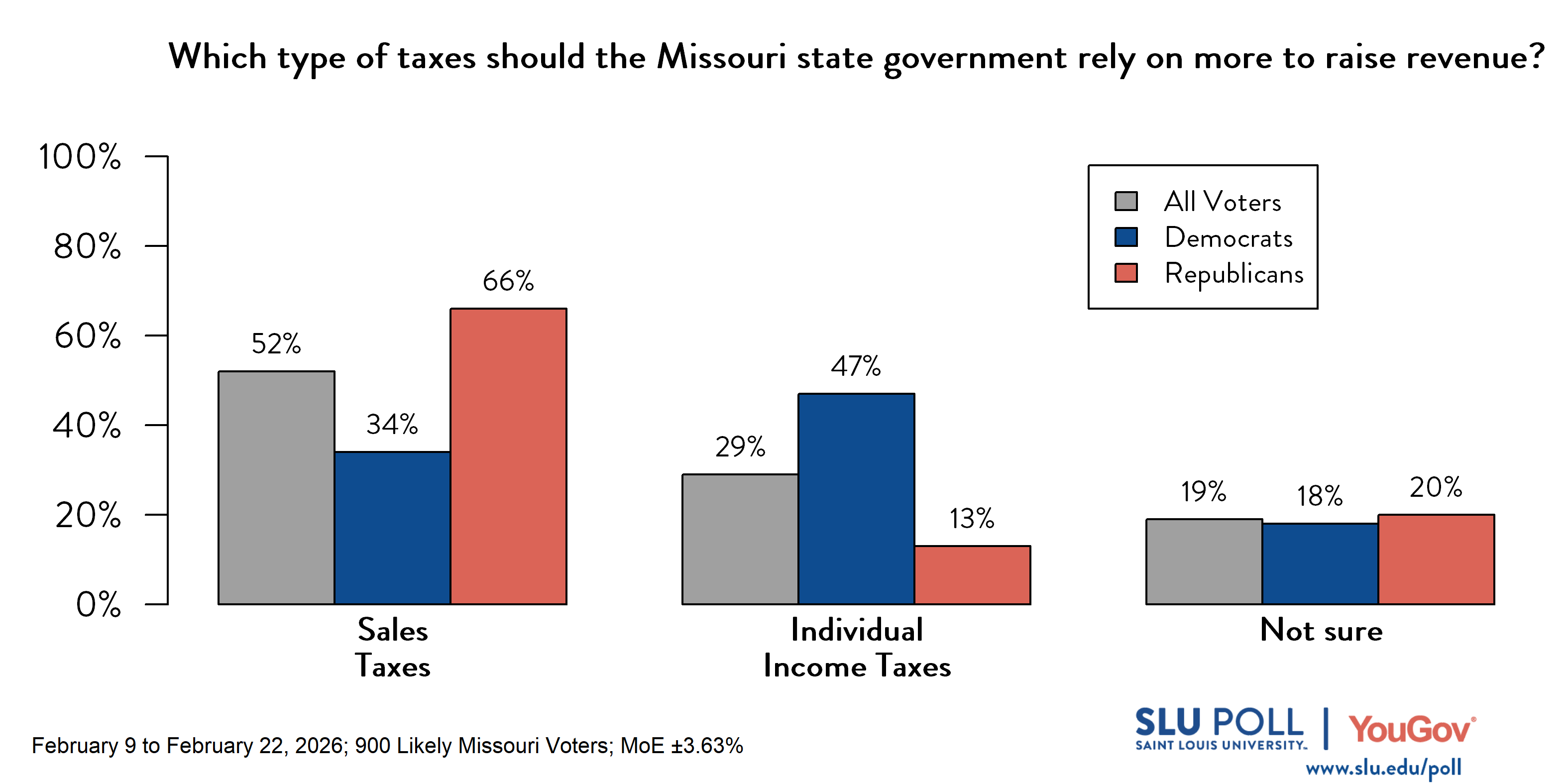 Likely voters' responses to 'In general, which type of taxes do you think the Missouri
state government should rely on more to raise revenue?': 52% Sales taxes, 29% Individual
income taxes, and 19% Not sure. Democratic voters' responses: 34% Sales taxes, 47%
Individual income taxes, and 18% Not sure. Republican voters' responses: 66% Sales
taxes, 13% Individual income taxes, and 20% Not sure.
Likely voters' responses to 'In general, which type of taxes do you think the Missouri
state government should rely on more to raise revenue?': 52% Sales taxes, 29% Individual
income taxes, and 19% Not sure. Democratic voters' responses: 34% Sales taxes, 47%
Individual income taxes, and 18% Not sure. Republican voters' responses: 66% Sales
taxes, 13% Individual income taxes, and 20% Not sure.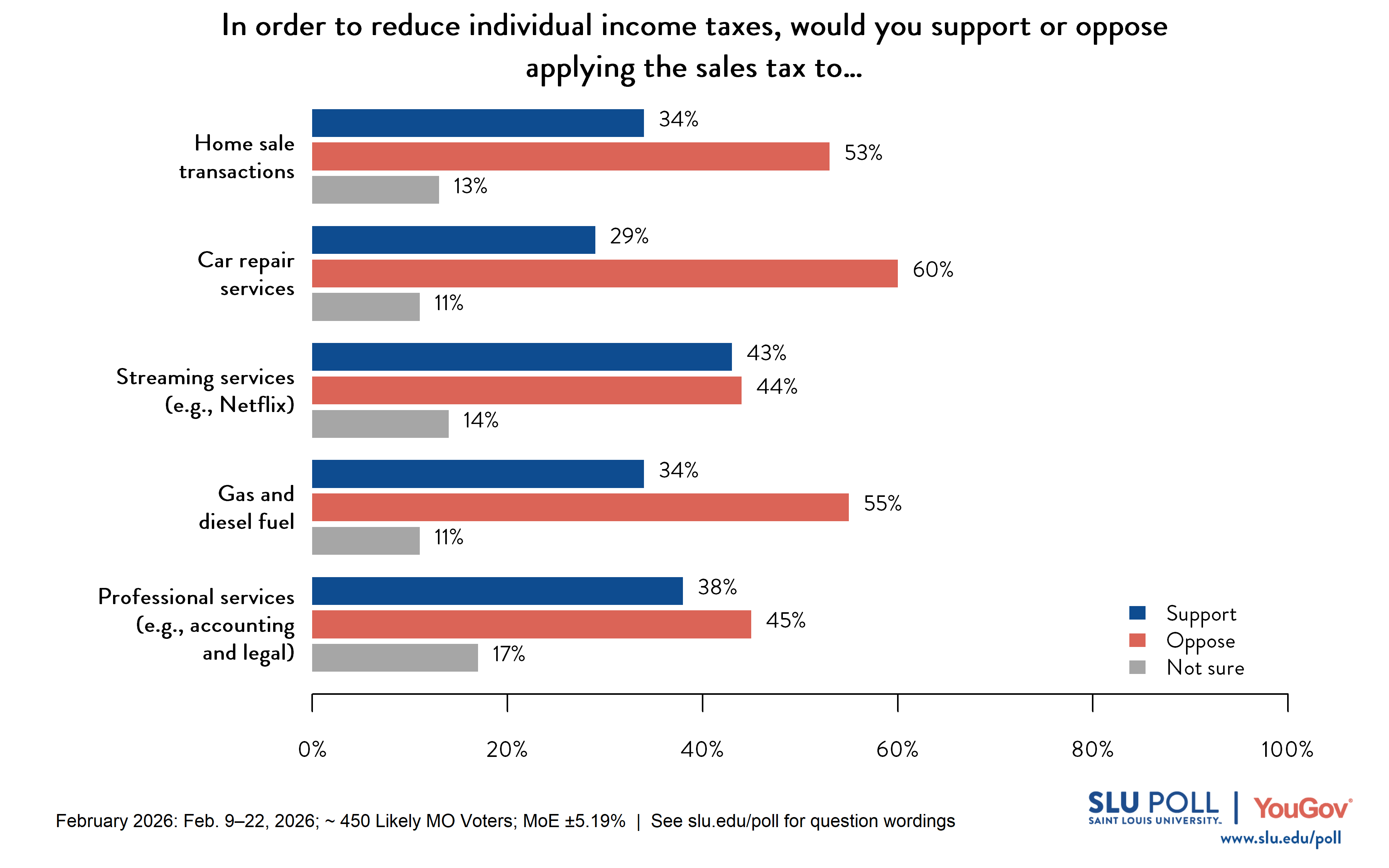 This graph presents likely voters' responses to five questions about whether they
would support or oppose applying the sales tax to various goods and services in order
to reduce individual income taxes. Opposition exceeds support for most categories.
Car repair services draw the most opposition (60% oppose, 29% support, 11% not sure),
followed by gas and diesel fuel (55% oppose, 34% support, 11% not sure), and home
sale transactions (53% oppose, 34% support, 13% not sure). Voters are more closely
divided on professional services such as accounting and legal (45% oppose, 38% support,
17% not sure) and streaming services such as Netflix (44% oppose, 43% support, 14%
not sure).
This graph presents likely voters' responses to five questions about whether they
would support or oppose applying the sales tax to various goods and services in order
to reduce individual income taxes. Opposition exceeds support for most categories.
Car repair services draw the most opposition (60% oppose, 29% support, 11% not sure),
followed by gas and diesel fuel (55% oppose, 34% support, 11% not sure), and home
sale transactions (53% oppose, 34% support, 13% not sure). Voters are more closely
divided on professional services such as accounting and legal (45% oppose, 38% support,
17% not sure) and streaming services such as Netflix (44% oppose, 43% support, 14%
not sure). Data Centers
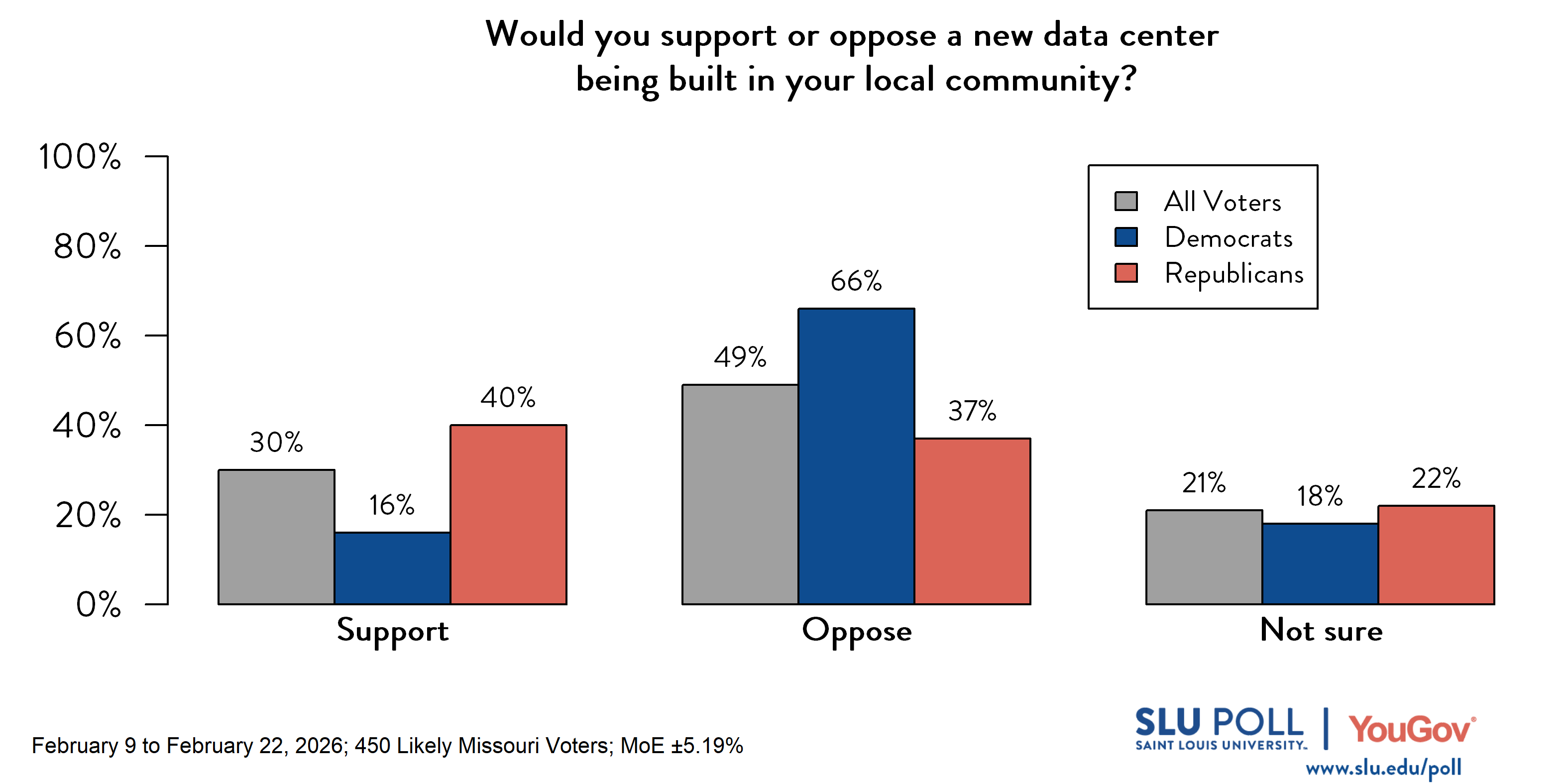 Likely voters' responses to 'Would you support or oppose a new data center - which
is a large facility that houses computer servers for storing and transmitting data
- being built in your local community?': 30% Support, 49% Oppose, and 21% Not sure.
Democratic voters' responses: 16% Support, 66% Oppose, and 18% Not sure. Republican
voters' responses: 40% Support, 37% Oppose, and 22% Not sure.
Likely voters' responses to 'Would you support or oppose a new data center - which
is a large facility that houses computer servers for storing and transmitting data
- being built in your local community?': 30% Support, 49% Oppose, and 21% Not sure.
Democratic voters' responses: 16% Support, 66% Oppose, and 18% Not sure. Republican
voters' responses: 40% Support, 37% Oppose, and 22% Not sure.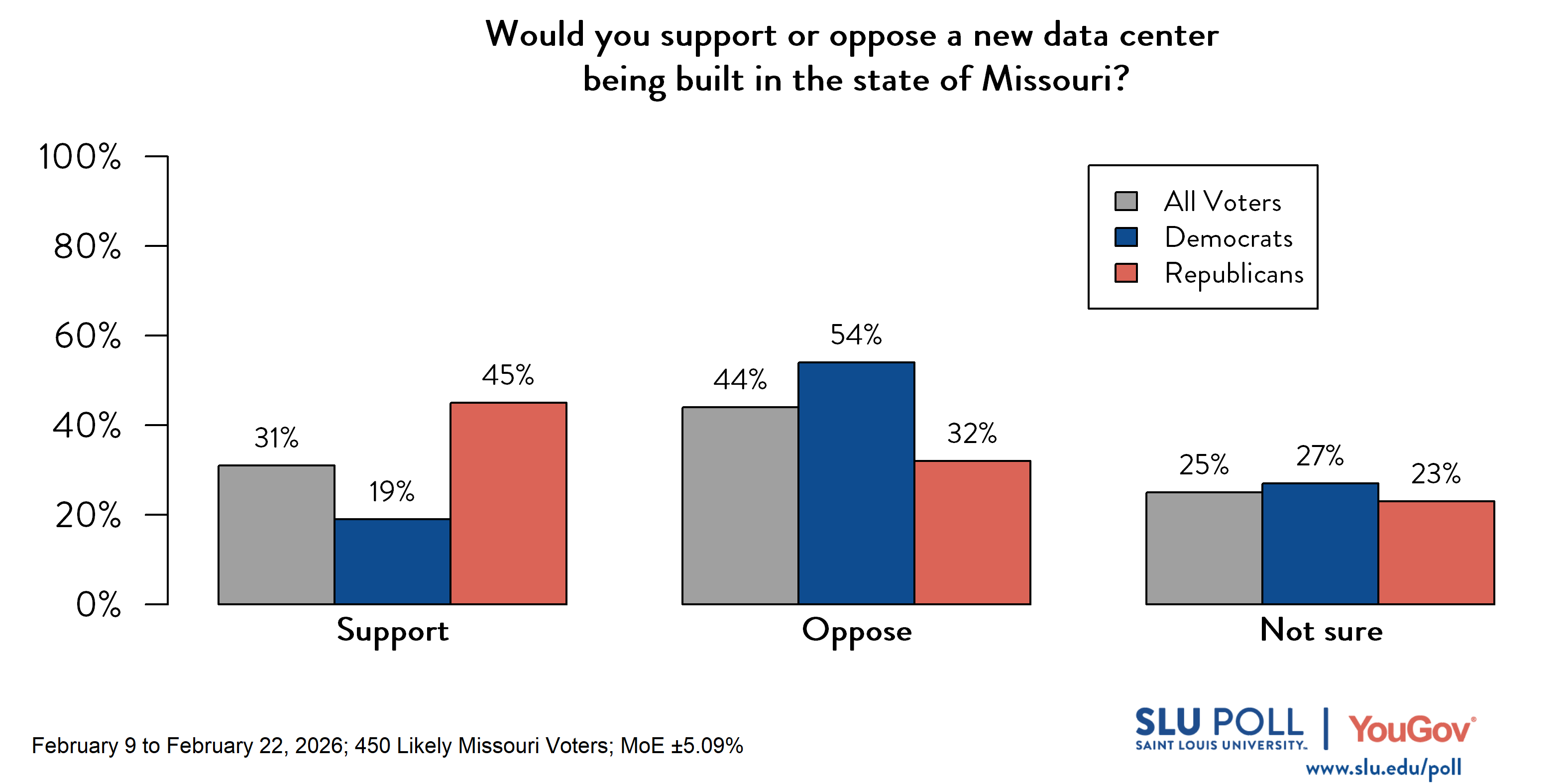 Likely voters' responses to 'Would you support or oppose a new data center - which
is a large facility that houses computer servers for storing and transmitting data
- being built in the state of Missouri?': 31% Support, 44% Oppose, and 25% Not sure.
Democratic voters' responses: 19% Support, 54% Oppose, and 27% Not sure. Republican
voters' responses: 45% Support, 32% Oppose, and 23% Not sure.
Likely voters' responses to 'Would you support or oppose a new data center - which
is a large facility that houses computer servers for storing and transmitting data
- being built in the state of Missouri?': 31% Support, 44% Oppose, and 25% Not sure.
Democratic voters' responses: 19% Support, 54% Oppose, and 27% Not sure. Republican
voters' responses: 45% Support, 32% Oppose, and 23% Not sure. Immigration and Customs Enforcement (ICE)
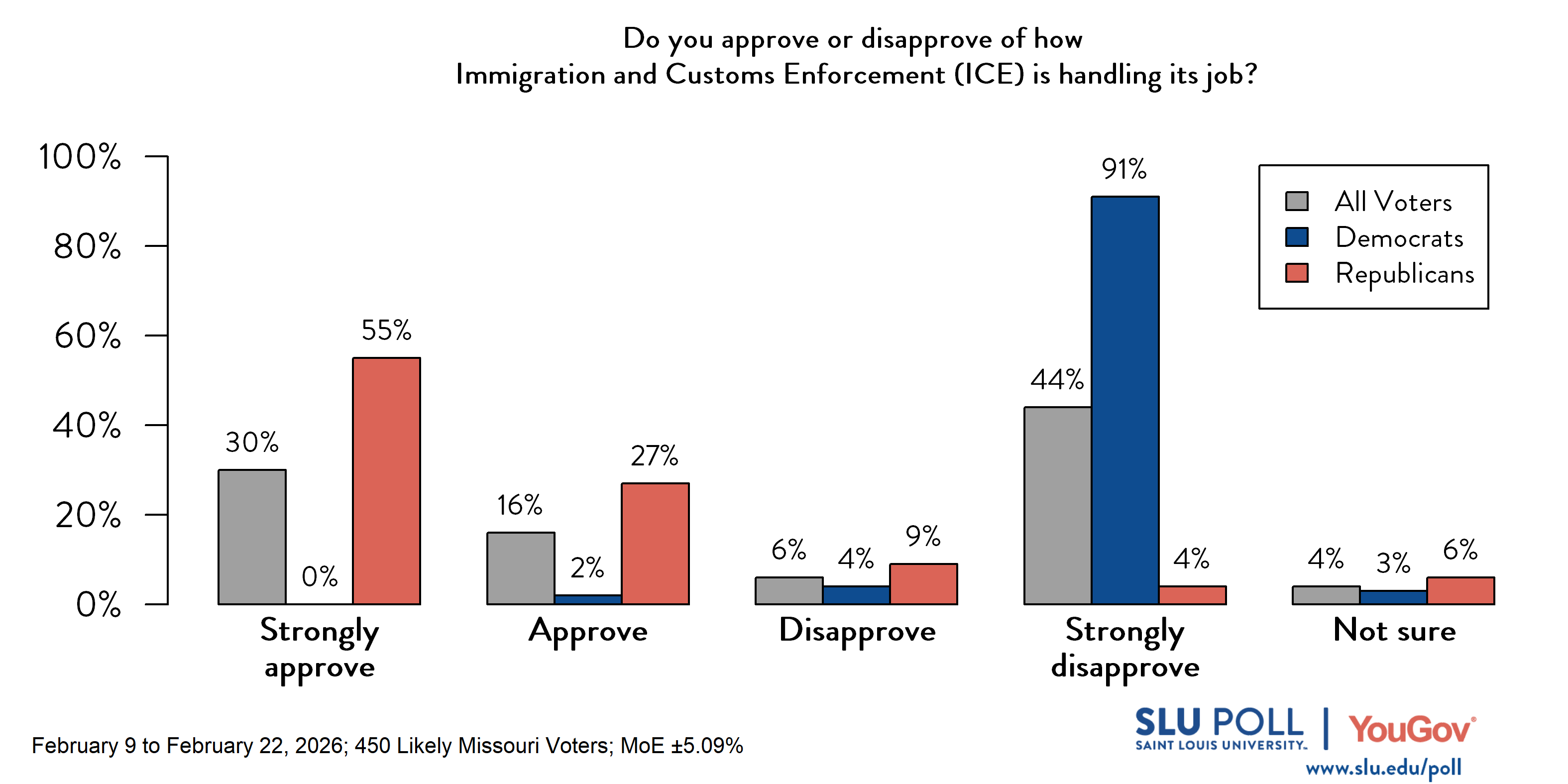 Likely voters' responses to 'Do you approve or disapprove of how Immigration and Customs
Enforcement (ICE) is handling its job?': 30% Strongly approve, 16% Approve, 6% Disapprove,
44% Strongly disapprove, and 4% Not sure. Democratic voters' responses: 0% Strongly
approve, 2% Approve, 4% Disapprove, 91% Strongly disapprove, and 3% Not sure. Republican
voters' responses: 55% Strongly approve, 27% Approve, 9% Disapprove, 4% Strongly disapprove,
and 6% Not sure.
Likely voters' responses to 'Do you approve or disapprove of how Immigration and Customs
Enforcement (ICE) is handling its job?': 30% Strongly approve, 16% Approve, 6% Disapprove,
44% Strongly disapprove, and 4% Not sure. Democratic voters' responses: 0% Strongly
approve, 2% Approve, 4% Disapprove, 91% Strongly disapprove, and 3% Not sure. Republican
voters' responses: 55% Strongly approve, 27% Approve, 9% Disapprove, 4% Strongly disapprove,
and 6% Not sure.Education
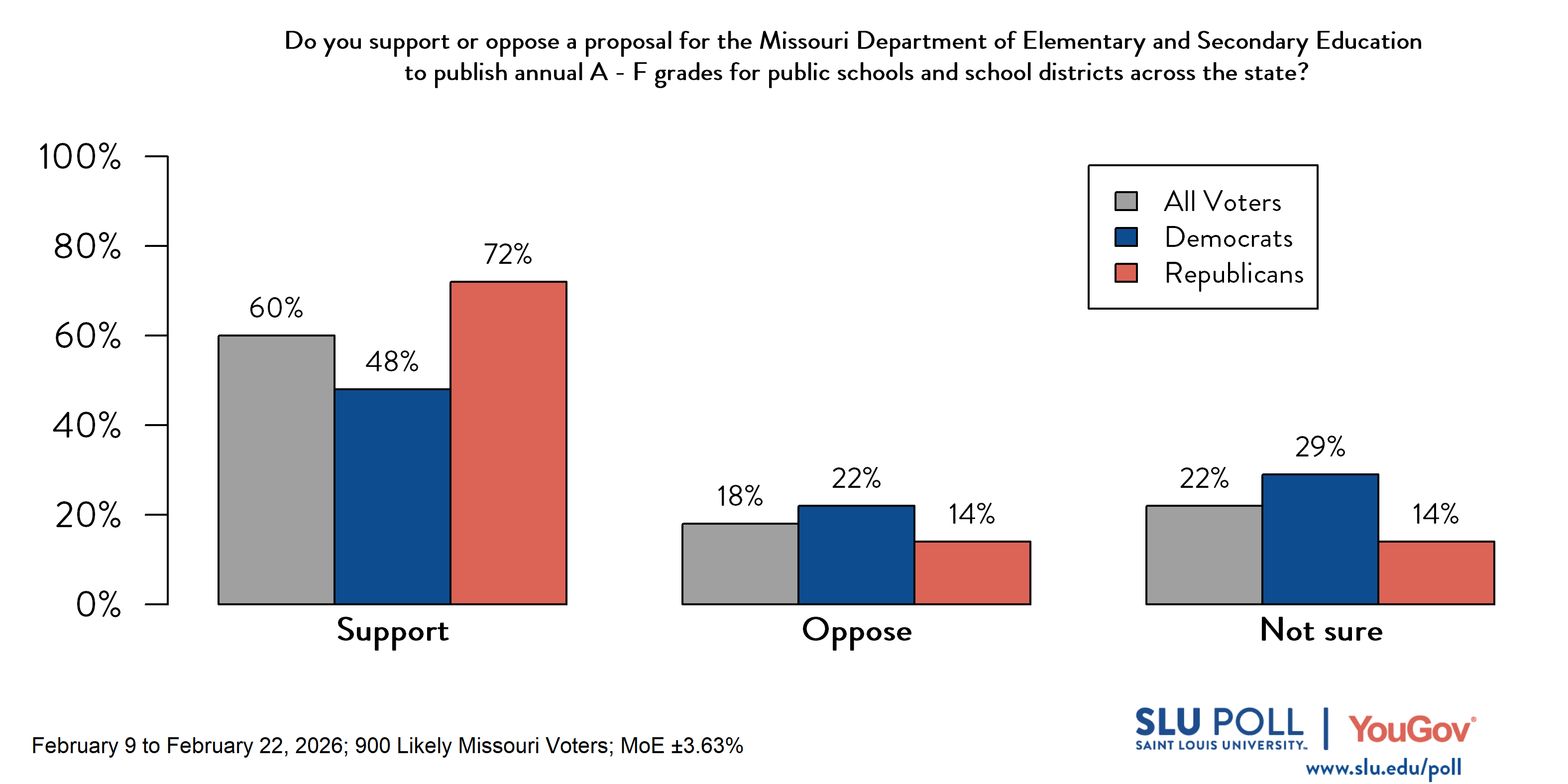 Likely voters' responses to 'There is a proposal for the Missouri Department of Elementary
and Secondary Education to publish annual A - F (similar to a report card) for public
schools and school districts across the state. Grades will mainly be based on state
test results and graduation rates...Do you support or oppose this proposal?': 60%
Support, 18% Oppose, and 22% Not sure. Democratic voters' responses: 48% Support,
22% Oppose, and 29% Not sure. Republican voters' responses: 72% Support, 14% Oppose,
and 14% Not sure.
Likely voters' responses to 'There is a proposal for the Missouri Department of Elementary
and Secondary Education to publish annual A - F (similar to a report card) for public
schools and school districts across the state. Grades will mainly be based on state
test results and graduation rates...Do you support or oppose this proposal?': 60%
Support, 18% Oppose, and 22% Not sure. Democratic voters' responses: 48% Support,
22% Oppose, and 29% Not sure. Republican voters' responses: 72% Support, 14% Oppose,
and 14% Not sure.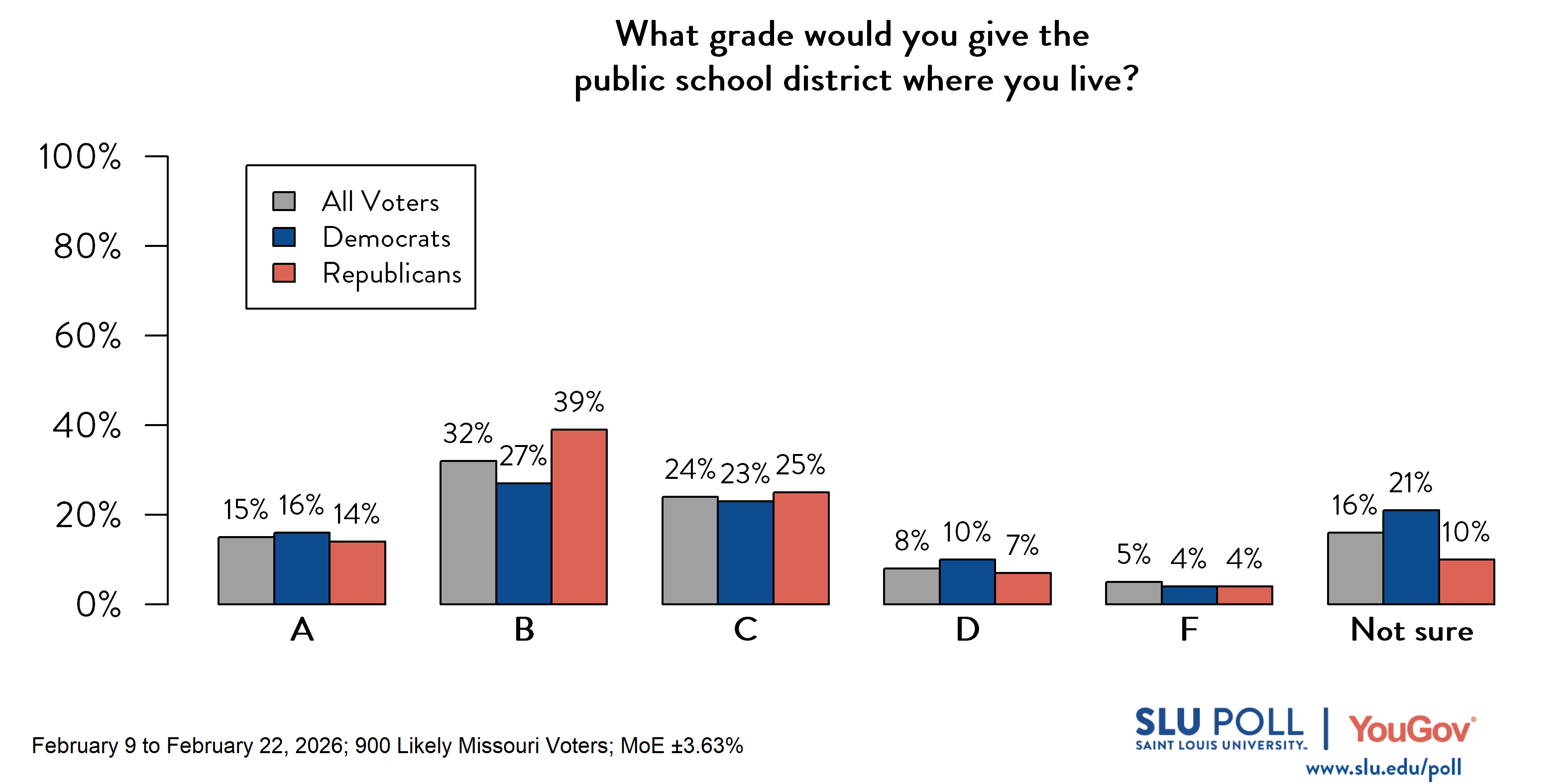 Likely voters' responses to 'What grade would you give the public school district
where you live?': 15% A, 32% B, 24% C, 8% D, 5% F, and 16% Not sure. Democratic voters'
responses: 16% A, 27% B, 23% C, 10% D, 4% F, and 21% Not sure. Republican voters'
responses: 14% A, 39% B, 25% C, 7% D, 4% F, and 10% Not sure.
Likely voters' responses to 'What grade would you give the public school district
where you live?': 15% A, 32% B, 24% C, 8% D, 5% F, and 16% Not sure. Democratic voters'
responses: 16% A, 27% B, 23% C, 10% D, 4% F, and 21% Not sure. Republican voters'
responses: 14% A, 39% B, 25% C, 7% D, 4% F, and 10% Not sure.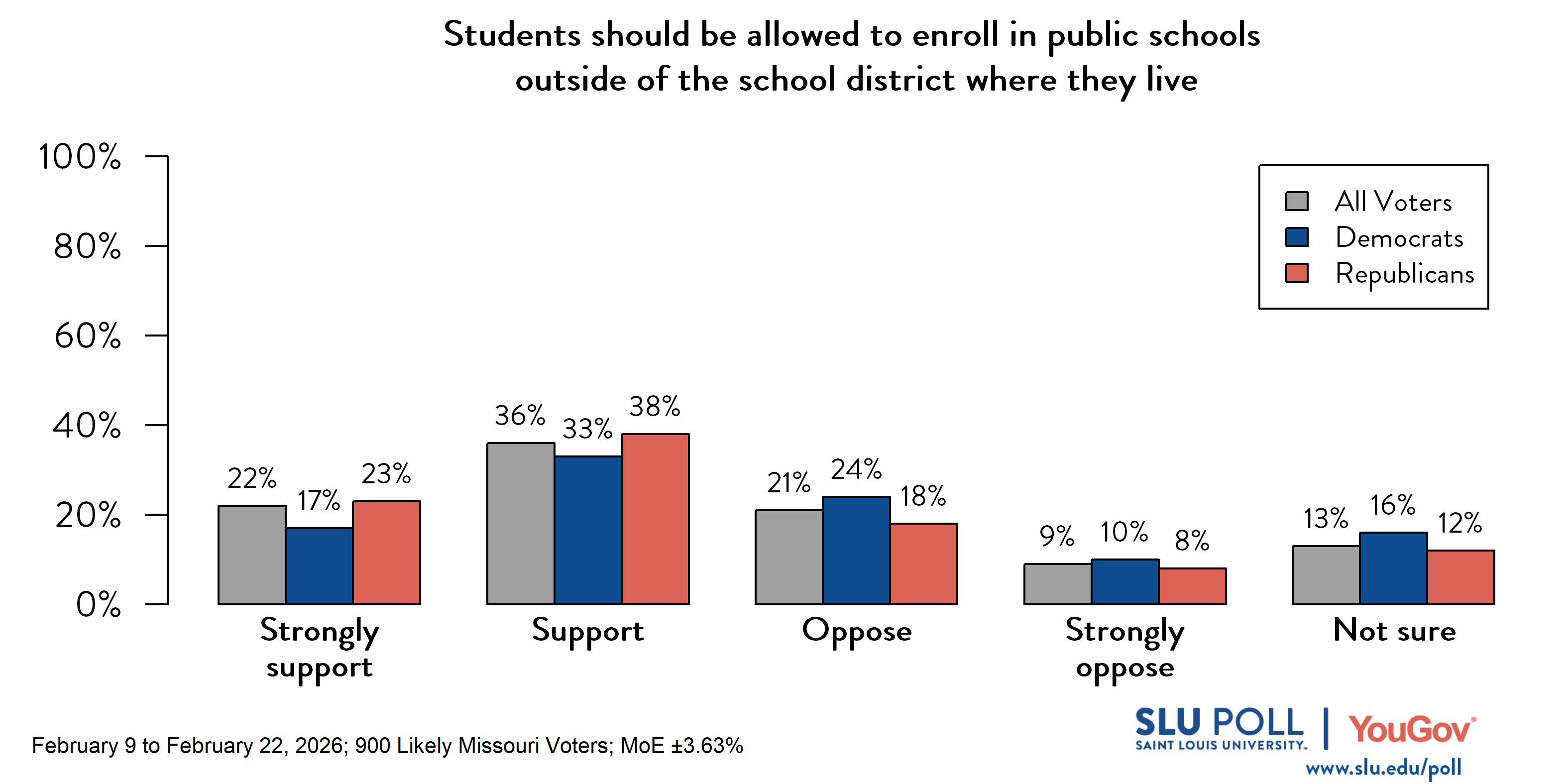 Likely voters' responses to 'Do you support or oppose the following policies...allowing
students to enroll in public schools outside of the school district where they live?':
22% Strongly support, 36% Support, 21% Oppose, 9% Strongly oppose, and 13% Not sure.
Democratic voters' responses: 17% Strongly support, 33% Support, 24% Oppose, 10% Strongly
oppose, and 16% Not sure. Republican voters' responses: 23% Strongly support, 38%
Support, 18% Oppose, 8% Strongly oppose, and 12% Not sure.
Likely voters' responses to 'Do you support or oppose the following policies...allowing
students to enroll in public schools outside of the school district where they live?':
22% Strongly support, 36% Support, 21% Oppose, 9% Strongly oppose, and 13% Not sure.
Democratic voters' responses: 17% Strongly support, 33% Support, 24% Oppose, 10% Strongly
oppose, and 16% Not sure. Republican voters' responses: 23% Strongly support, 38%
Support, 18% Oppose, 8% Strongly oppose, and 12% Not sure. 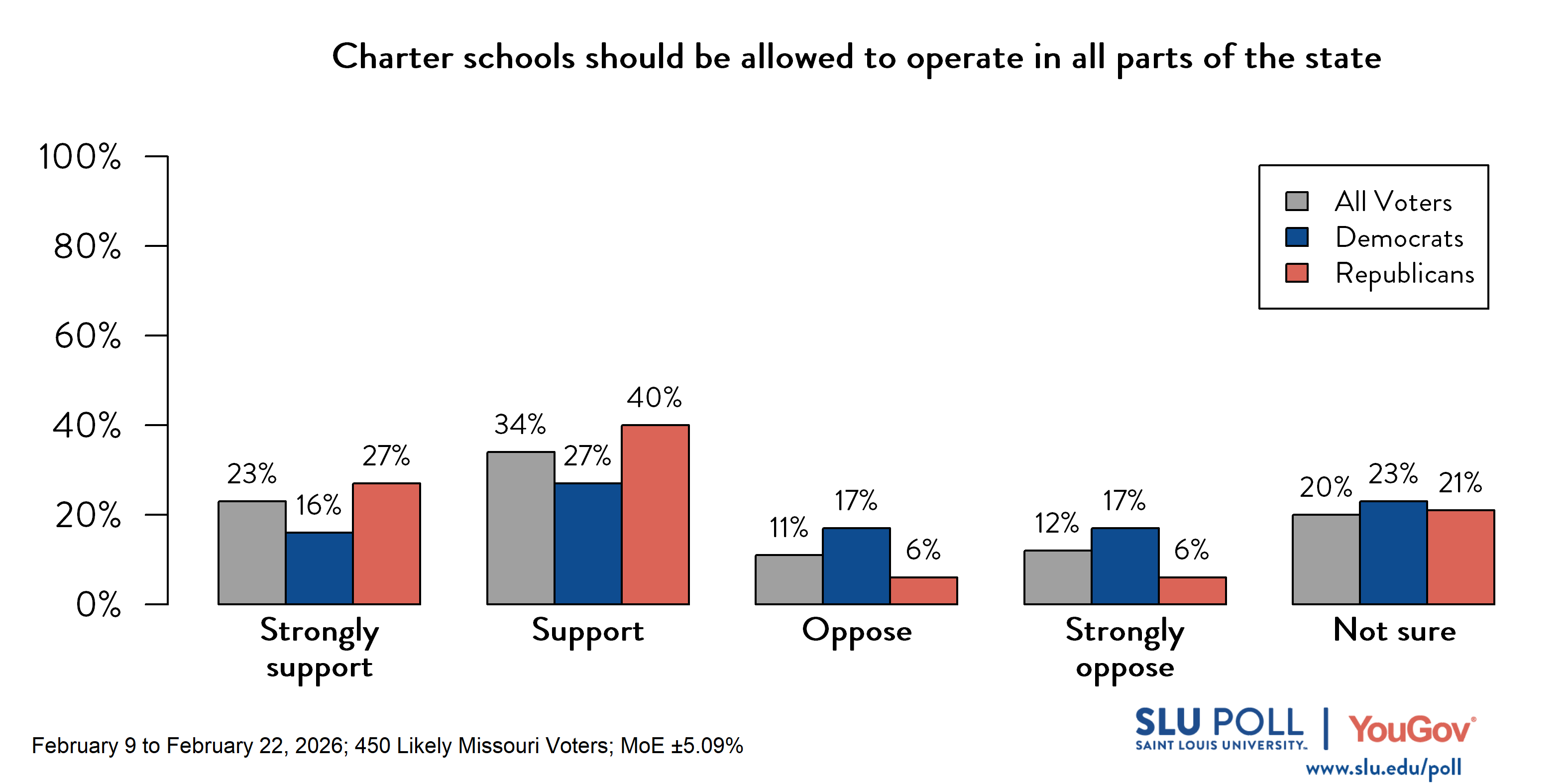 Likely voters' responses to 'Do you support or oppose the following policies...allowing
charter schools to operate in all parts of the state?': 23% Strongly support, 34%
Support, 11% Oppose, 12% Strongly oppose, and 20% Not sure. Democratic voters' responses:
16% Strongly support, 27% Support, 17% Oppose, 17% Strongly oppose, and 23% Not sure.
Republican voters' responses: 27% Strongly support, 40% Support, 6% Oppose, 6% Strongly
oppose, and 21% Not sure. Likely voters' responses to 'Do you support or oppose the following policies...allowing
public charter schools to operate in all parts of the state?': 29% Strongly support,
32% Support, 10% Oppose, 9% Strongly oppose, and 19% Not sure. Democratic voters'
responses: 20% Strongly support, 30% Support, 15% Oppose, 16% Strongly oppose, and
18% Not sure. Republican voters' responses: 34% Strongly support, 37% Support, 8%
Oppose, 3% Strongly oppose, and 19% Not sure.
Likely voters' responses to 'Do you support or oppose the following policies...allowing
charter schools to operate in all parts of the state?': 23% Strongly support, 34%
Support, 11% Oppose, 12% Strongly oppose, and 20% Not sure. Democratic voters' responses:
16% Strongly support, 27% Support, 17% Oppose, 17% Strongly oppose, and 23% Not sure.
Republican voters' responses: 27% Strongly support, 40% Support, 6% Oppose, 6% Strongly
oppose, and 21% Not sure. Likely voters' responses to 'Do you support or oppose the following policies...allowing
public charter schools to operate in all parts of the state?': 29% Strongly support,
32% Support, 10% Oppose, 9% Strongly oppose, and 19% Not sure. Democratic voters'
responses: 20% Strongly support, 30% Support, 15% Oppose, 16% Strongly oppose, and
18% Not sure. Republican voters' responses: 34% Strongly support, 37% Support, 8%
Oppose, 3% Strongly oppose, and 19% Not sure.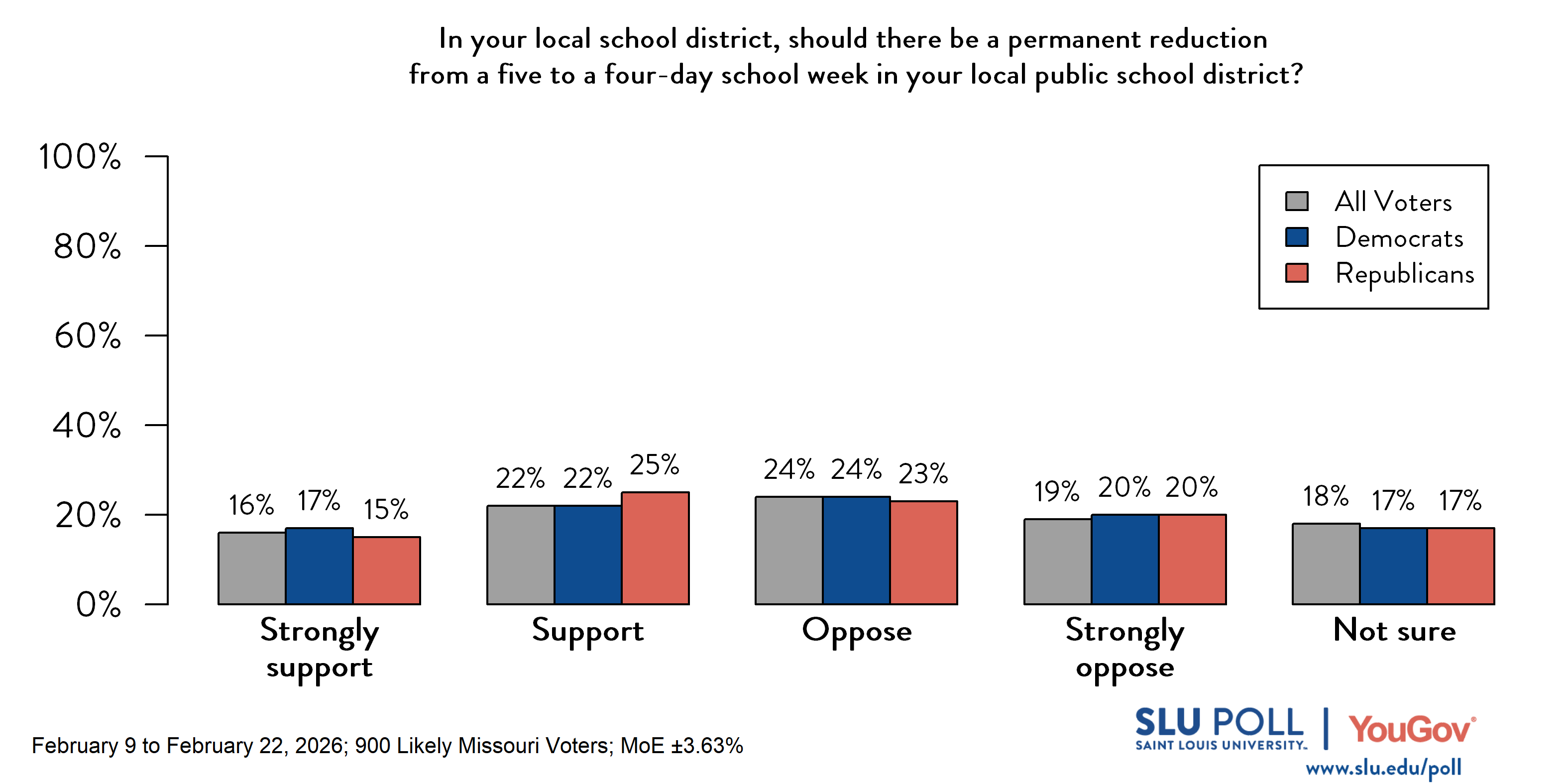 Likely voters' responses to 'Do you support or oppose the following policies...the
permanent reduction from a five to a four-day school week in your local public school
district?': 16% Strongly support, 22% Support, 24% Oppose, 19% Strongly oppose, and
18% Not sure. Democratic voters' responses: 17% Strongly support, 22% Support, 24%
Oppose, 20% Strongly oppose, and 17% Not sure. Republican voters' responses: 15% Strongly
support, 25% Support, 23% Oppose, 20% Strongly oppose, and 17% Not sure.
Likely voters' responses to 'Do you support or oppose the following policies...the
permanent reduction from a five to a four-day school week in your local public school
district?': 16% Strongly support, 22% Support, 24% Oppose, 19% Strongly oppose, and
18% Not sure. Democratic voters' responses: 17% Strongly support, 22% Support, 24%
Oppose, 20% Strongly oppose, and 17% Not sure. Republican voters' responses: 15% Strongly
support, 25% Support, 23% Oppose, 20% Strongly oppose, and 17% Not sure.Prescription Drugs
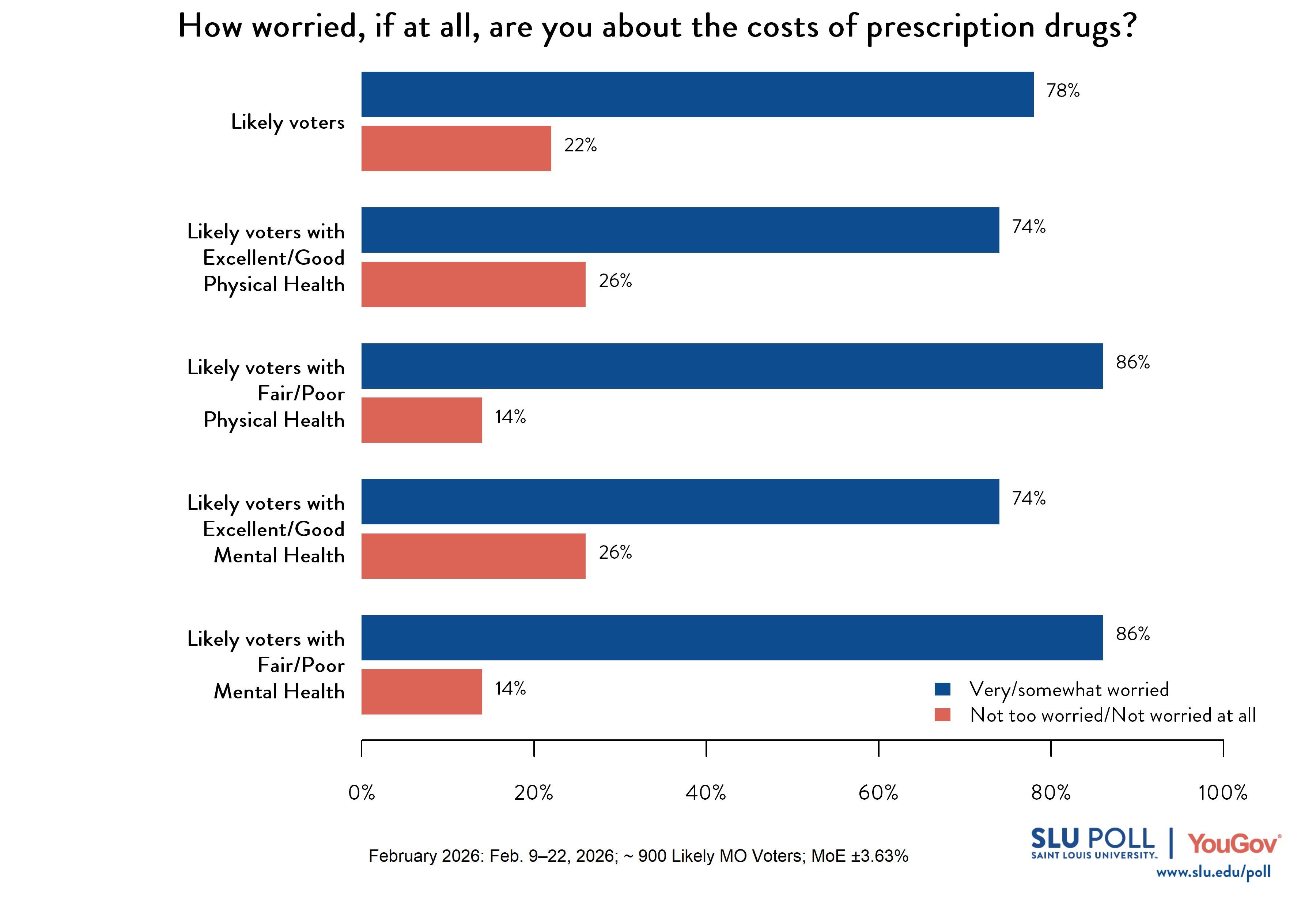 This graph presents likely voters' responses to the question 'How worried, if at all,
are you about the costs of prescription drugs?' broken down by self-reported physical
and mental health status. Concern about prescription drug costs is high across all
subgroups. Among all likely voters, 78% are very or somewhat worried about prescription
drug costs, while 22% are not too worried or not worried at all. Worry is somewhat
higher among voters in worse health: 86% of those with fair or poor physical health
are very or somewhat worried (14% not worried), compared to 74% of those with excellent
or good physical health (26% not worried). The same pattern holds for mental health
- 86% of voters with fair or poor mental health are very or somewhat worried (14%
not worried), compared to 74% of those with excellent or good mental health (26% not
worried).
This graph presents likely voters' responses to the question 'How worried, if at all,
are you about the costs of prescription drugs?' broken down by self-reported physical
and mental health status. Concern about prescription drug costs is high across all
subgroups. Among all likely voters, 78% are very or somewhat worried about prescription
drug costs, while 22% are not too worried or not worried at all. Worry is somewhat
higher among voters in worse health: 86% of those with fair or poor physical health
are very or somewhat worried (14% not worried), compared to 74% of those with excellent
or good physical health (26% not worried). The same pattern holds for mental health
- 86% of voters with fair or poor mental health are very or somewhat worried (14%
not worried), compared to 74% of those with excellent or good mental health (26% not
worried). 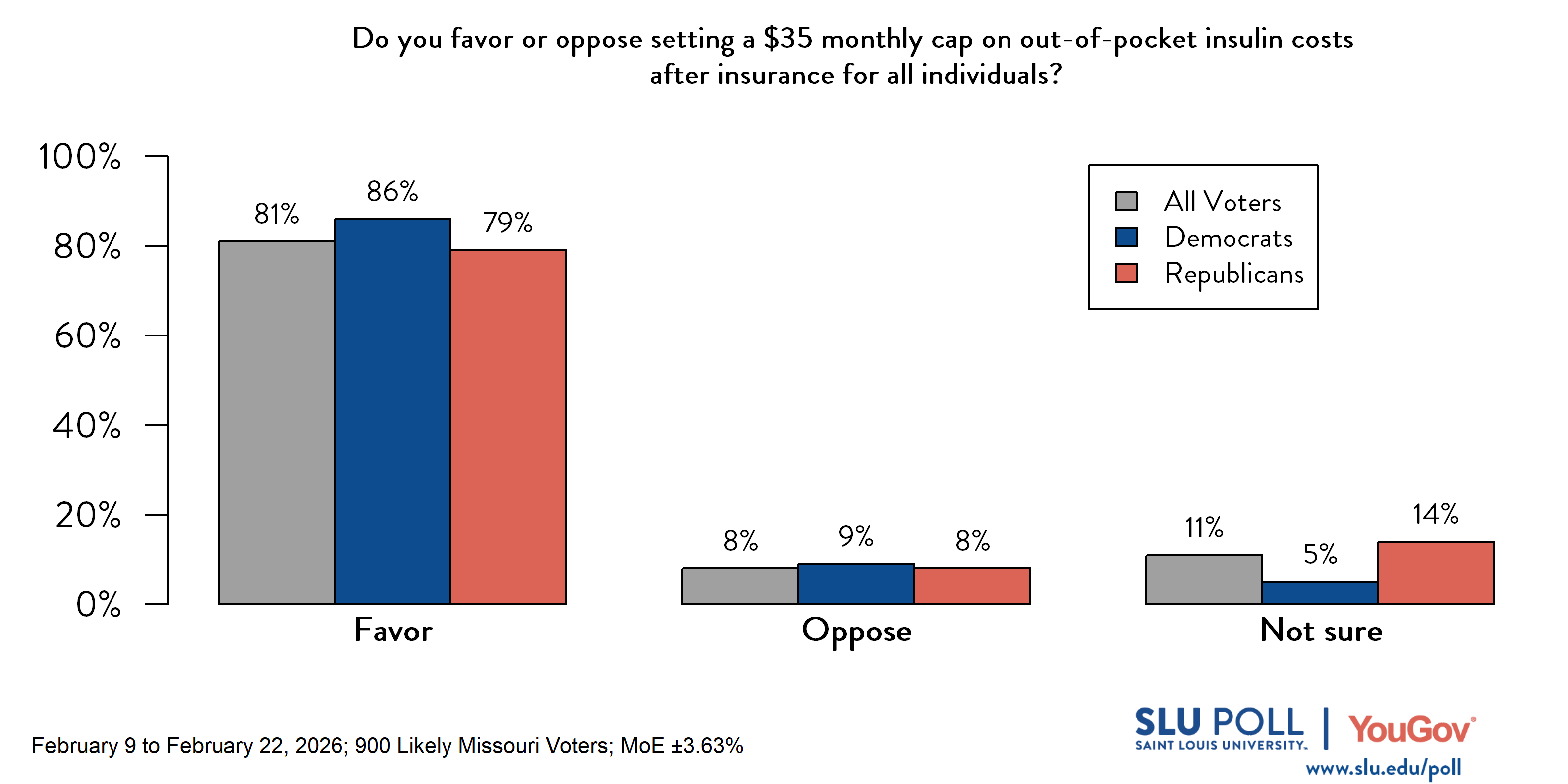 Likely voters' responses to 'Do you favor or oppose setting a $35 monthly cap on out-of-pocket
insulin costs, after insurance, for all individuals?': 81% Favor, 8% Oppose, and 11%
Not sure. Democratic voters' responses: 86% Favor, 9% Oppose, and 5% Not sure. Republican
voters' responses: 79% Favor, 8% Oppose, and 14% Not sure.
Likely voters' responses to 'Do you favor or oppose setting a $35 monthly cap on out-of-pocket
insulin costs, after insurance, for all individuals?': 81% Favor, 8% Oppose, and 11%
Not sure. Democratic voters' responses: 86% Favor, 9% Oppose, and 5% Not sure. Republican
voters' responses: 79% Favor, 8% Oppose, and 14% Not sure.SNAP Eligibility for Felons
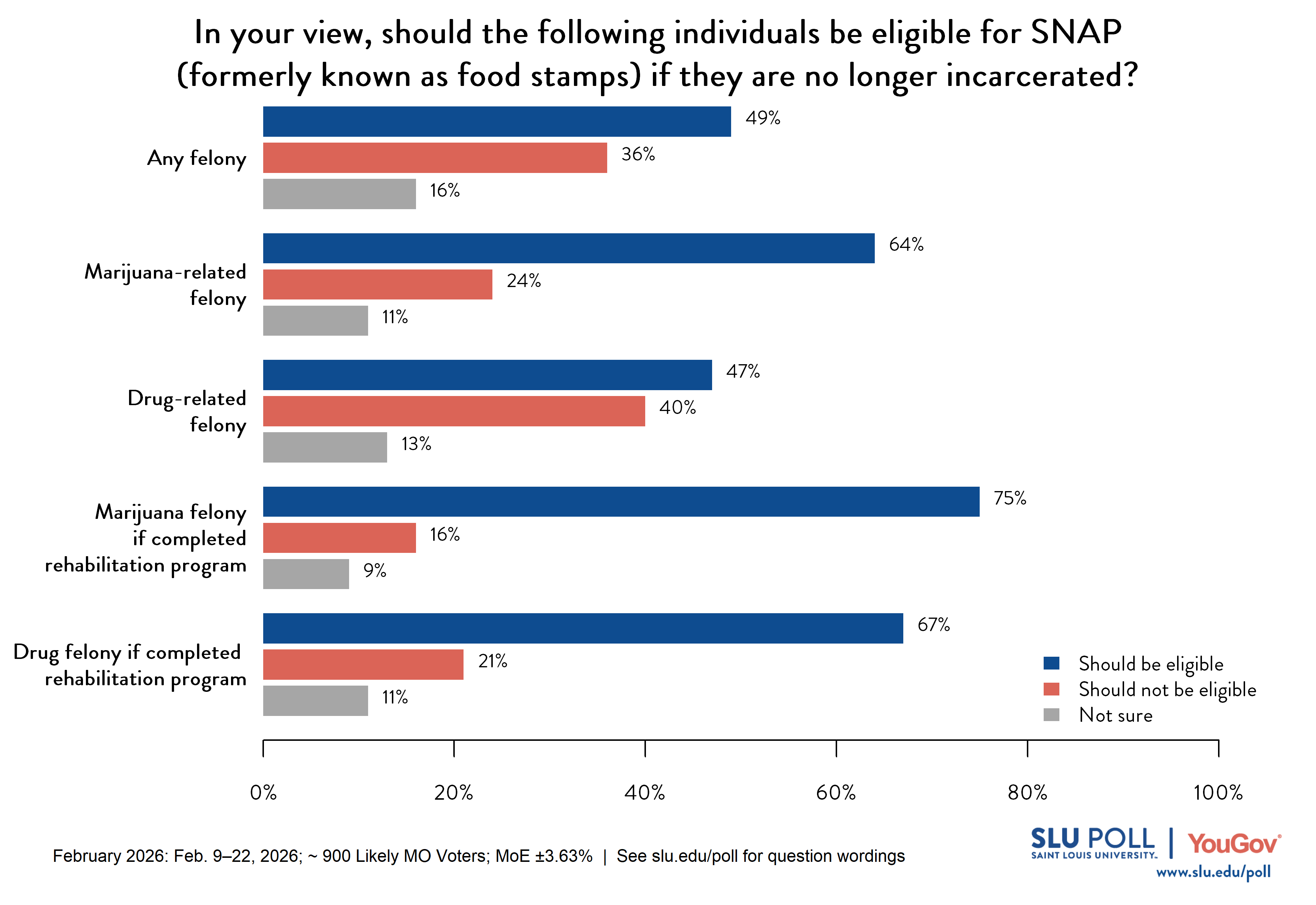 This graph presents likely voters' responses to five questions about whether formerly
incarcerated individuals should be eligible for SNAP benefits (formerly known as food
stamps). Support for eligibility is highest when a rehabilitation program has been
completed - 75% say a marijuana felon who has completed a rehabilitation program should
be eligible (16% should not, 9% not sure), and 67% say the same for a drug felon who
has completed a rehabilitation program (21% should not, 11% not sure). For a marijuana-related
felony without a rehabilitation requirement, 64% say the individual should be eligible
(24% should not, 11% not sure). Support is somewhat lower for any felony conviction
generally, with 49% saying those individuals should be eligible (36% should not, 16%
not sure), and for a drug-related felony, with 47% saying they should be eligible
(40% should not, 13% not sure).
This graph presents likely voters' responses to five questions about whether formerly
incarcerated individuals should be eligible for SNAP benefits (formerly known as food
stamps). Support for eligibility is highest when a rehabilitation program has been
completed - 75% say a marijuana felon who has completed a rehabilitation program should
be eligible (16% should not, 9% not sure), and 67% say the same for a drug felon who
has completed a rehabilitation program (21% should not, 11% not sure). For a marijuana-related
felony without a rehabilitation requirement, 64% say the individual should be eligible
(24% should not, 11% not sure). Support is somewhat lower for any felony conviction
generally, with 49% saying those individuals should be eligible (36% should not, 16%
not sure), and for a drug-related felony, with 47% saying they should be eligible
(40% should not, 13% not sure).Capital Punishment
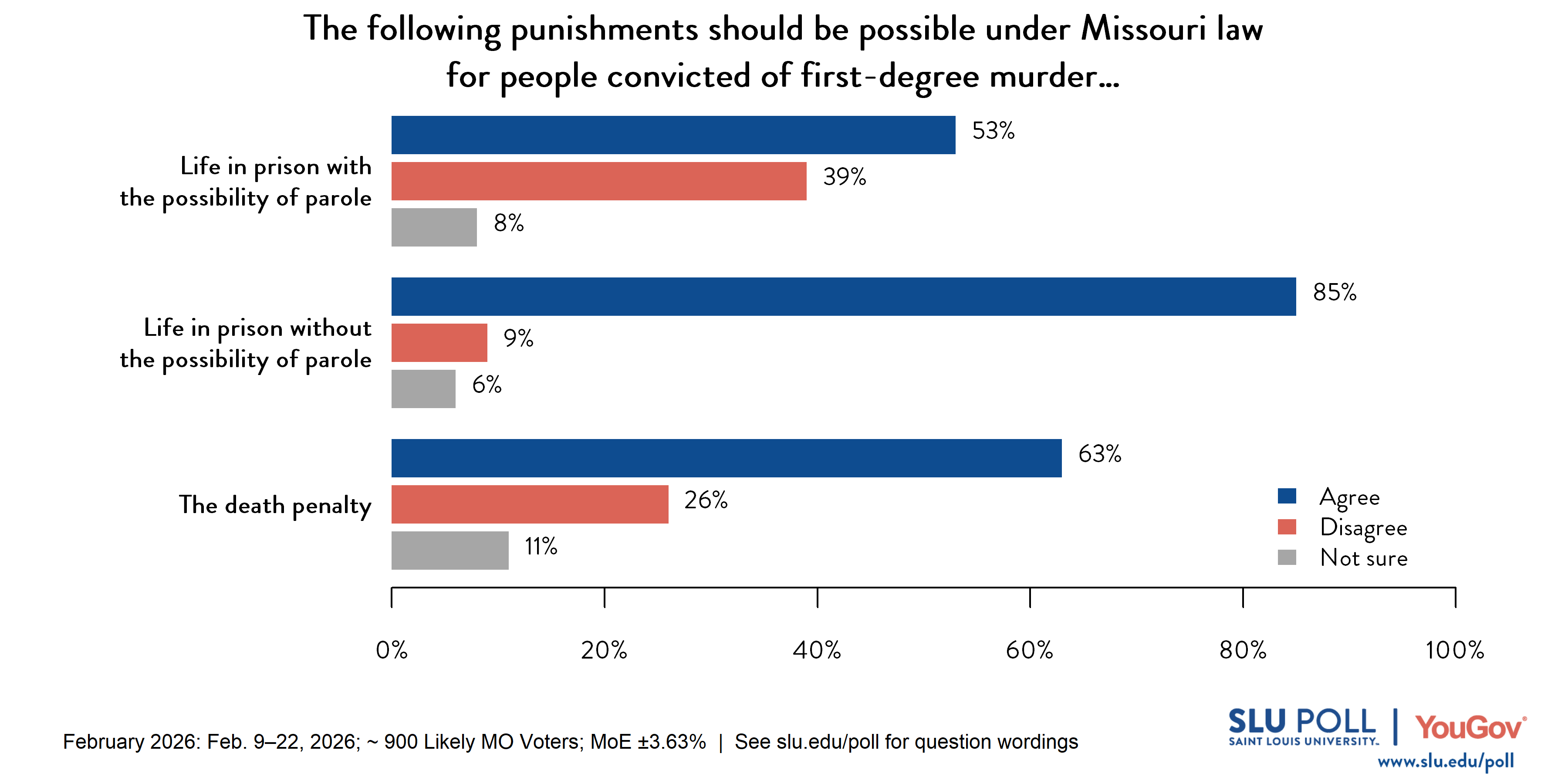 This graph presents likely voters' responses to three questions about whether certain
punishments should be possible under Missouri law for people convicted of first-degree
murder. Support is highest for life in prison without the possibility of parole, with
85% agreeing it should be a possible punishment (9% disagree, 6% not sure). The death
penalty is supported by 63% as a possible punishment (26% disagree, 11% not sure).
Life in prison with the possibility of parole receives majority support at 53% (39%
disagree, 8% not sure).
This graph presents likely voters' responses to three questions about whether certain
punishments should be possible under Missouri law for people convicted of first-degree
murder. Support is highest for life in prison without the possibility of parole, with
85% agreeing it should be a possible punishment (9% disagree, 6% not sure). The death
penalty is supported by 63% as a possible punishment (26% disagree, 11% not sure).
Life in prison with the possibility of parole receives majority support at 53% (39%
disagree, 8% not sure).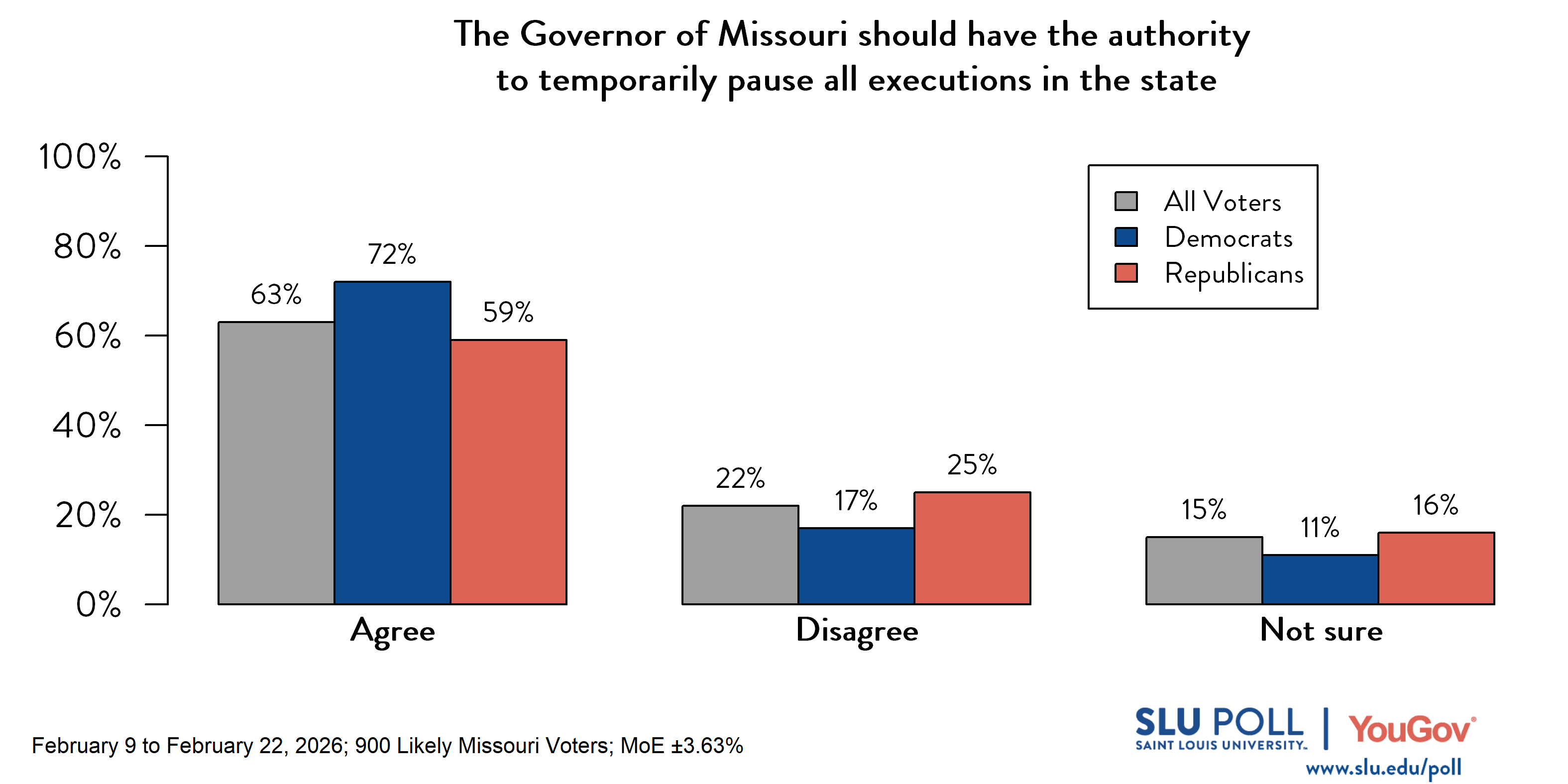 Likely voters' responses to 'Do you agree or disagree that the Governor of Missouri
should have the authority to temporarily pause all executions in the state?': 63%
Agree, 22% Disagree, and 15% Not sure. Democratic voters' responses: 72% Agree, 17%
Disagree, and 11% Not sure. Republican voters' responses: 59% Agree, 25% Disagree,
and 16% Not sure.
Likely voters' responses to 'Do you agree or disagree that the Governor of Missouri
should have the authority to temporarily pause all executions in the state?': 63%
Agree, 22% Disagree, and 15% Not sure. Democratic voters' responses: 72% Agree, 17%
Disagree, and 11% Not sure. Republican voters' responses: 59% Agree, 25% Disagree,
and 16% Not sure.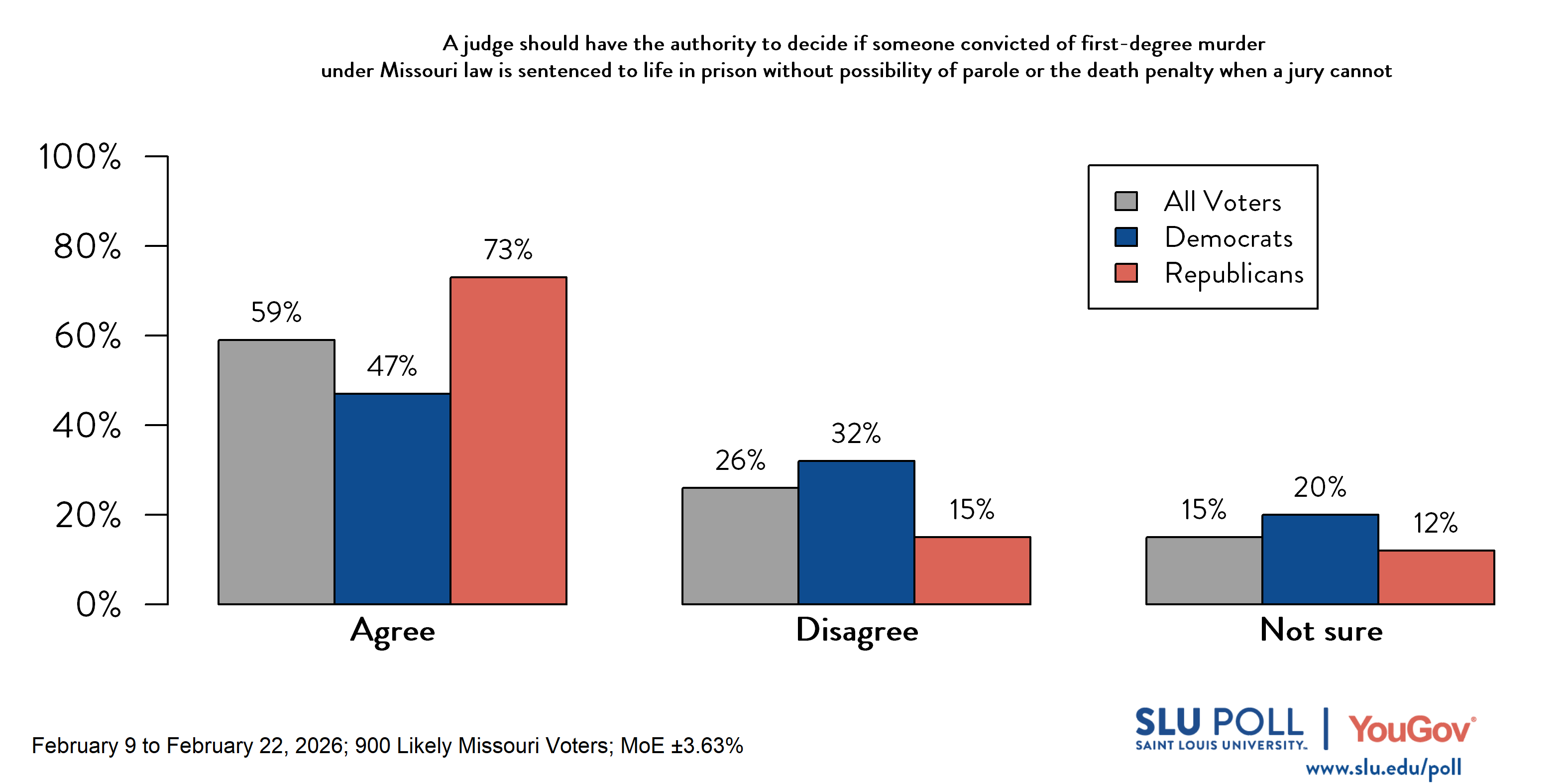 Likely voters' responses to 'Under Missouri law, if a jury cannot unanimously agree
to sentence someone convicted of first-degree murder to life in prison without the
possibility of parole or the death penalty, a judge may decide whether the sentence
is life in prison without the possibility of parole or the death penalty...Do you
agree or disagree that the judge should have the authority to make this decision?':
59% Agree, 26% Disagree, and 15% Not sure. Democratic voters' responses: 47% Agree,
32% Disagree, and 20% Not sure. Republican voters' responses: 73% Agree, 15% Disagree,
and 12% Not sure.
Likely voters' responses to 'Under Missouri law, if a jury cannot unanimously agree
to sentence someone convicted of first-degree murder to life in prison without the
possibility of parole or the death penalty, a judge may decide whether the sentence
is life in prison without the possibility of parole or the death penalty...Do you
agree or disagree that the judge should have the authority to make this decision?':
59% Agree, 26% Disagree, and 15% Not sure. Democratic voters' responses: 47% Agree,
32% Disagree, and 20% Not sure. Republican voters' responses: 73% Agree, 15% Disagree,
and 12% Not sure.Statewide Opinion Over Time
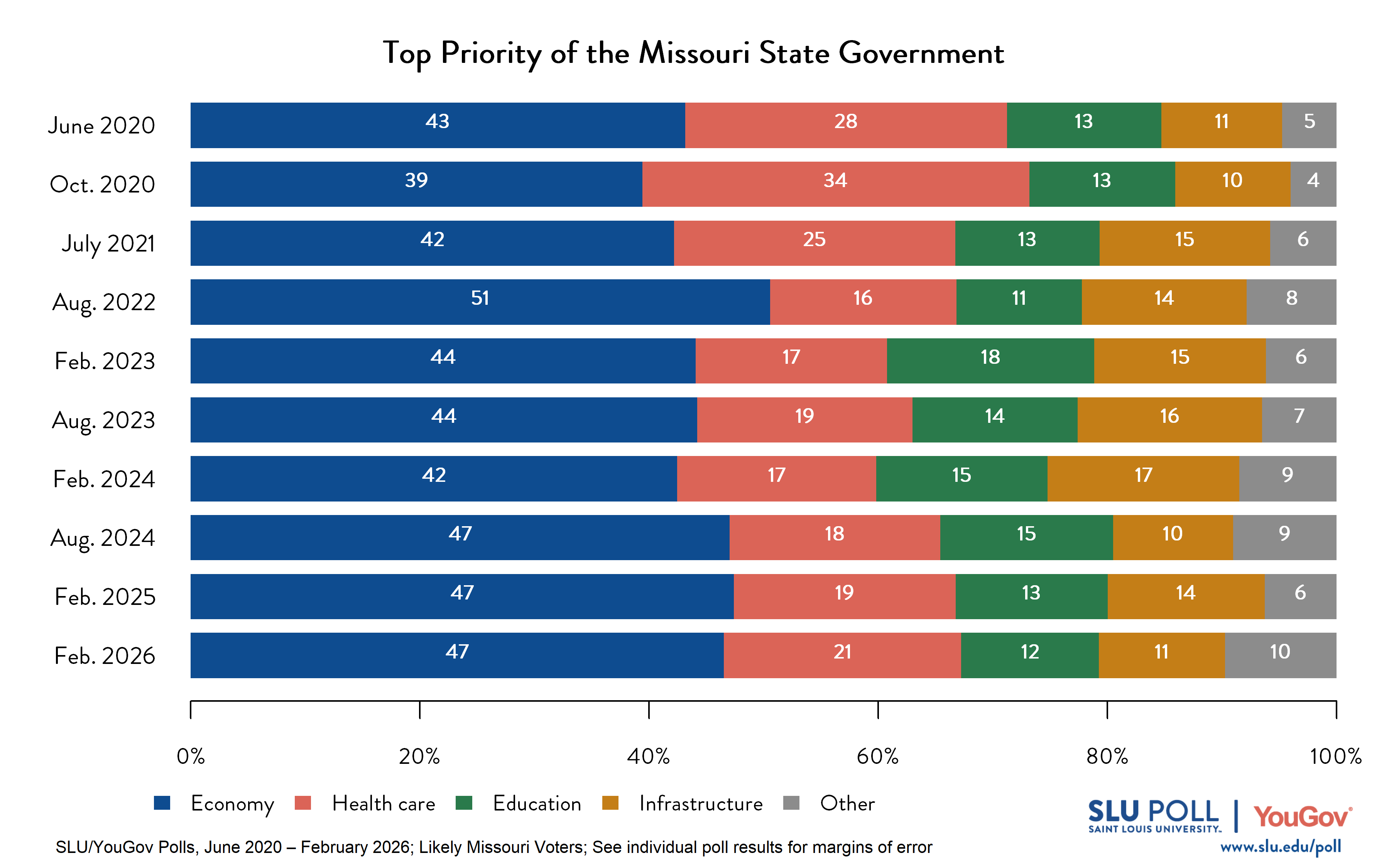
Likely voters' responses to 'Which of the following do you think should be the TOP priority of the Missouri state government?'. June 2020 Voter Responses: 43% Economy, 28% Health Care, 13% Education, 11% Infrastructure, and 5% Other. October 2020 Voter Responses: 39% Economy, 34% Health care, 13% Education, 10% Infrastructure, and 4% Other. July 2021 Voter Responses: 42% Economy, 25% Health care, 13% Education, 15% Infrastructure, and 6% Other. August 2022 Voter Responses: 51% Economy, 16% Health care, 11% Education, 14% Infrastructure, and 8% Other. February 2023 Voter Responses: 44% Economy, 17% Health care, 18% Education, 15% Infrastructure, and 6% Other. August 2023 Voter Responses: 44% Economy, 19% Health care, 14% Education, 16% Infrastructure, and 7% Other. February 2024 Voter Responses: 42% Economy, 17% Health care, 15% Education, 17% Infrastructure, and 9% Other. August 2024 Voter Responses: 47% Economy, 18% Health care, 15% Education, 10% Infrastructure, and 9% Other. February 2025 Voter Responses: 47% Economy, 19% Health care, 13% Education, 14% Infrastructure, and 6% Other. February 2026 Voter Responses: 47% Economy, 21% Health care, 12% Education, 11% Infrastructure, and 10% Other.
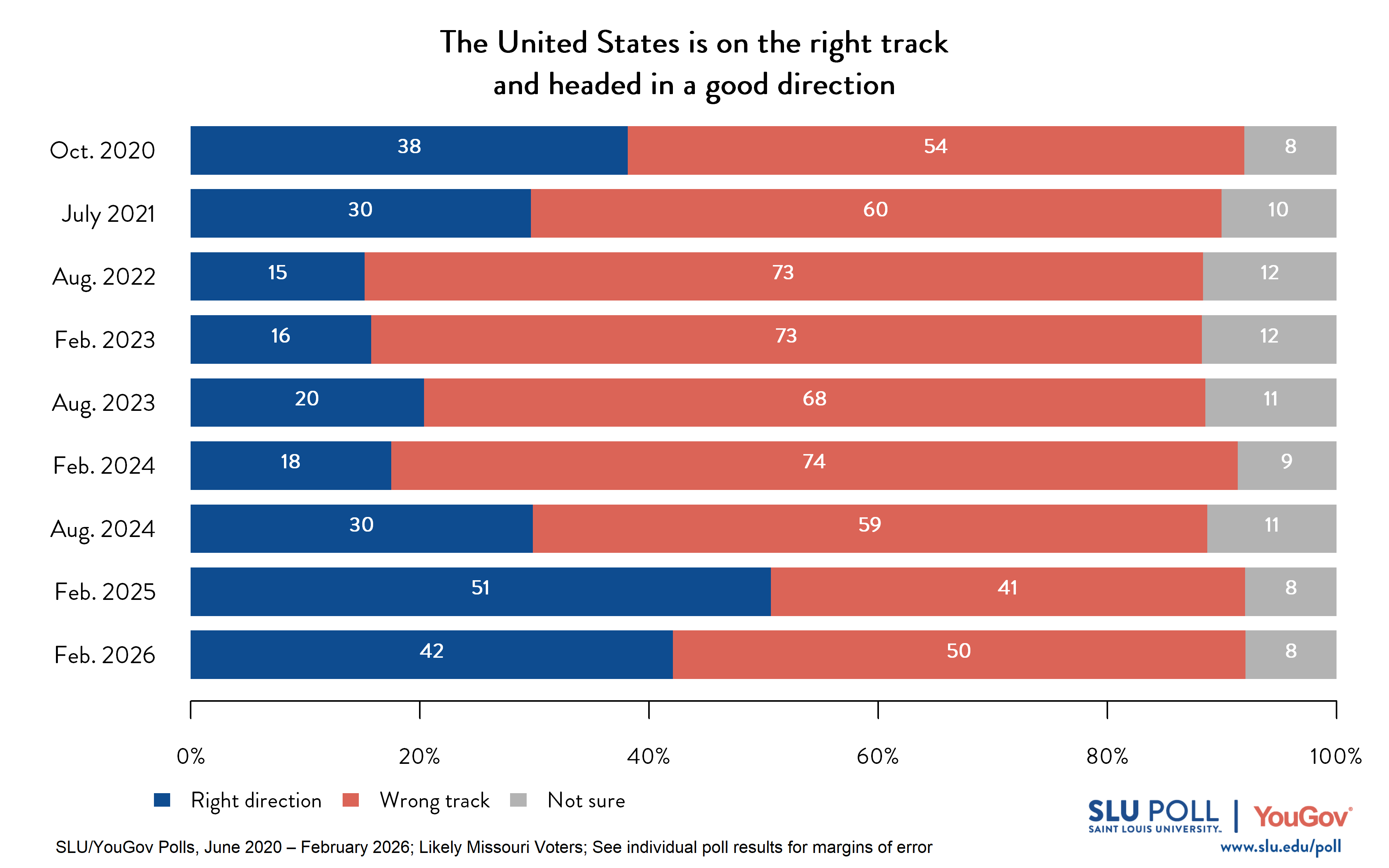 Likely voters' responses to 'Do you agree or disagree with the following statements...The
United States is on the right track and headed in a good direction?'. October 2020
Voter Responses: 38% Agree, 54% Disagree, and 8% Not sure. July 2021 Voter Responses:
30% Agree, 60% Disagree, and 10% Not sure. August 2022 Voter Responses: 15% Agree,
73% Disagree, and 12% Not Sure. February 2023 Voter Responses: 16% Agree, 73% Disagree,
and 12% Not sure. August 2023 Voter Responses: 20% Agree, 68% Disagree, and 11% Not
Sure. February 2024 Voter Responses: 18% Agree, 74% Disagree, and 9% Not Sure. August
2024 Voter Responses: 30% Agree, 59% Disagree, and 11% Not Sure. February 2025 Voter
Responses: 51% Agree, 41% Disagree, and 8% Not sure. February 2026 Voter Responses:
42% Agree, 50% Disagree, and 8% Not sure.
Likely voters' responses to 'Do you agree or disagree with the following statements...The
United States is on the right track and headed in a good direction?'. October 2020
Voter Responses: 38% Agree, 54% Disagree, and 8% Not sure. July 2021 Voter Responses:
30% Agree, 60% Disagree, and 10% Not sure. August 2022 Voter Responses: 15% Agree,
73% Disagree, and 12% Not Sure. February 2023 Voter Responses: 16% Agree, 73% Disagree,
and 12% Not sure. August 2023 Voter Responses: 20% Agree, 68% Disagree, and 11% Not
Sure. February 2024 Voter Responses: 18% Agree, 74% Disagree, and 9% Not Sure. August
2024 Voter Responses: 30% Agree, 59% Disagree, and 11% Not Sure. February 2025 Voter
Responses: 51% Agree, 41% Disagree, and 8% Not sure. February 2026 Voter Responses:
42% Agree, 50% Disagree, and 8% Not sure. 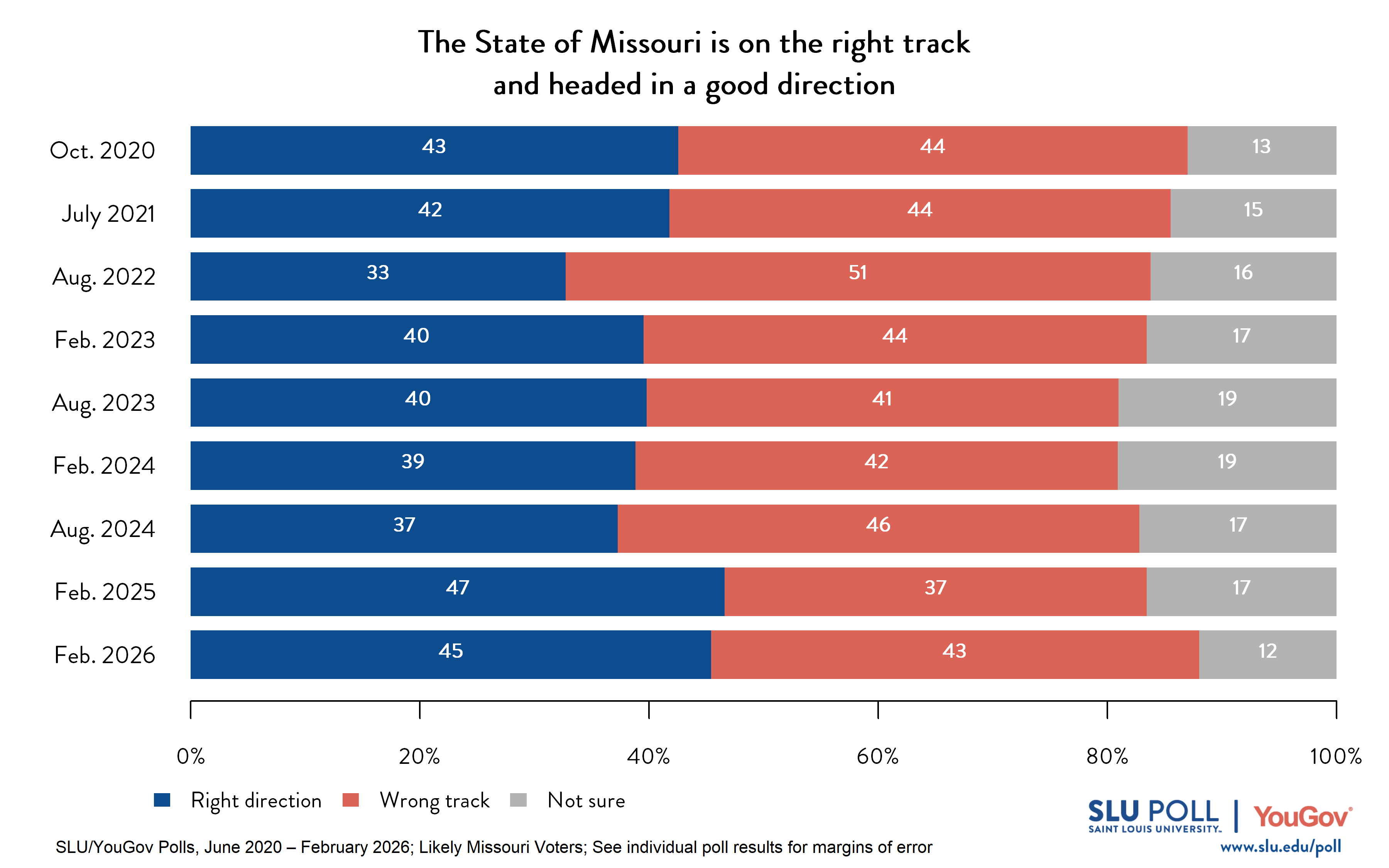 Likely voters' responses to 'Do you agree or disagree with the following statements...The
State of Missouri is on the right track and headed in a good direction?'. October
2020 Voter Responses: 43% Agree, 44% Disagree, and 13% Not sure. July 2021 Voter Responses:
42% Agree, 44% Disagree, and 15% Not sure. August 2022 Voter Responses: 33% Agree,
51% Disagree, and 16% Not Sure. February 2023 Voter Responses: 40% Agree, 44% Disagree,
and 17% Not sure. August 2023 Voter Responses: 40% Agree, 41% Disagree, and 19% Not
Sure. February 2024 Voter Responses: 39% Agree, 42% Disagree, and 19% Not Sure. August
2024 Voter Responses: 37% Agree, 46% Disagree, and 17% Not Sure. February 2025 Voter
Responses: 47% Agree, 37% Disagree, and 17% Not sure. February 2026 Voter Responses:
45% Agree, 43% Disagree, and 12% Not sure.
Likely voters' responses to 'Do you agree or disagree with the following statements...The
State of Missouri is on the right track and headed in a good direction?'. October
2020 Voter Responses: 43% Agree, 44% Disagree, and 13% Not sure. July 2021 Voter Responses:
42% Agree, 44% Disagree, and 15% Not sure. August 2022 Voter Responses: 33% Agree,
51% Disagree, and 16% Not Sure. February 2023 Voter Responses: 40% Agree, 44% Disagree,
and 17% Not sure. August 2023 Voter Responses: 40% Agree, 41% Disagree, and 19% Not
Sure. February 2024 Voter Responses: 39% Agree, 42% Disagree, and 19% Not Sure. August
2024 Voter Responses: 37% Agree, 46% Disagree, and 17% Not Sure. February 2025 Voter
Responses: 47% Agree, 37% Disagree, and 17% Not sure. February 2026 Voter Responses:
45% Agree, 43% Disagree, and 12% Not sure.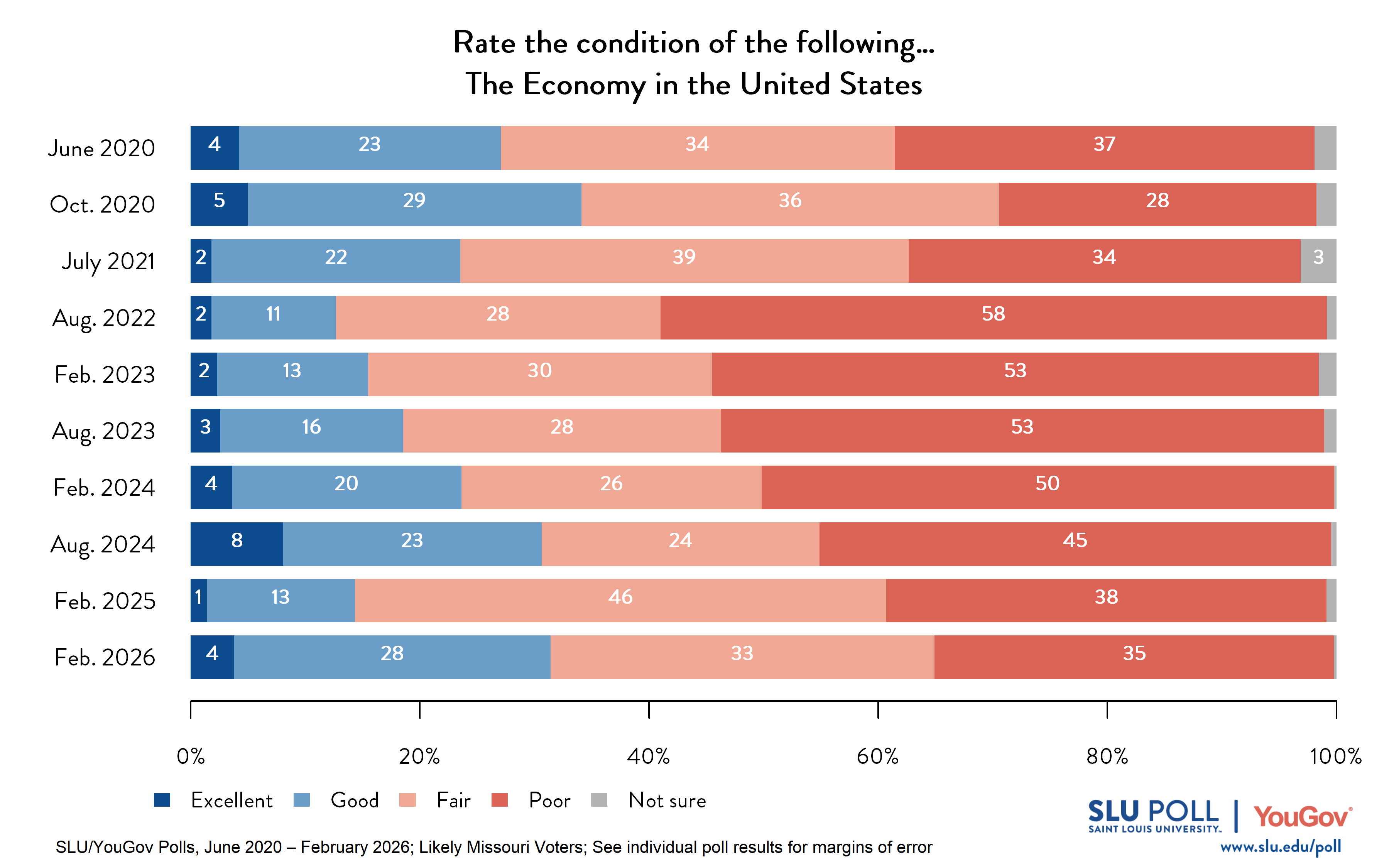 Likely voters' responses to 'How would you rate the following...The Economy in the
United States?'. June 2020 Voter Responses 4% Excellent, 23% Good, 34% Fair, 37% Poor,
and 2% Not Sure. October 2020 Voter Responses: 5% Excellent, 29% Good, 36% Fair, 28%
Poor, and 2% Not sure. July 2021 Voter Responses: 2% Excellent, 22% Good, 39% Fair,
34% Poor, and 3% Not sure. August 2022 Voter Responses: 2% Excellent, 11% Good, 28%
Fair, 58% Poor, and 1% Not sure. February 2023 Voter Responses: 2% Excellent, 13%
Good, 30% Fair, 53% Poor, and 2% Not sure. August 2023 Voter Responses: 3% Excellent,
16% Good, 28% Fair, 53% Poor, and 1% Not sure. February 2024 Voter Responses: 4% Excellent,
20% Good, 26% Fair, 50% Poor, and 0% Not sure. August 2024 Voter Responses: 8% Excellent,
23% Good, 24% Fair, 45% Poor, and 1% Not sure. February 2025 Voter Responses: 1% Excellent,
13% Good, 46% Fair, 38% Poor, and 1% Not sure. February 2026 Voter Responses: 4% Excellent,
28% Good, 33% Fair, 35% Poor, and 0% Not sure.
Likely voters' responses to 'How would you rate the following...The Economy in the
United States?'. June 2020 Voter Responses 4% Excellent, 23% Good, 34% Fair, 37% Poor,
and 2% Not Sure. October 2020 Voter Responses: 5% Excellent, 29% Good, 36% Fair, 28%
Poor, and 2% Not sure. July 2021 Voter Responses: 2% Excellent, 22% Good, 39% Fair,
34% Poor, and 3% Not sure. August 2022 Voter Responses: 2% Excellent, 11% Good, 28%
Fair, 58% Poor, and 1% Not sure. February 2023 Voter Responses: 2% Excellent, 13%
Good, 30% Fair, 53% Poor, and 2% Not sure. August 2023 Voter Responses: 3% Excellent,
16% Good, 28% Fair, 53% Poor, and 1% Not sure. February 2024 Voter Responses: 4% Excellent,
20% Good, 26% Fair, 50% Poor, and 0% Not sure. August 2024 Voter Responses: 8% Excellent,
23% Good, 24% Fair, 45% Poor, and 1% Not sure. February 2025 Voter Responses: 1% Excellent,
13% Good, 46% Fair, 38% Poor, and 1% Not sure. February 2026 Voter Responses: 4% Excellent,
28% Good, 33% Fair, 35% Poor, and 0% Not sure.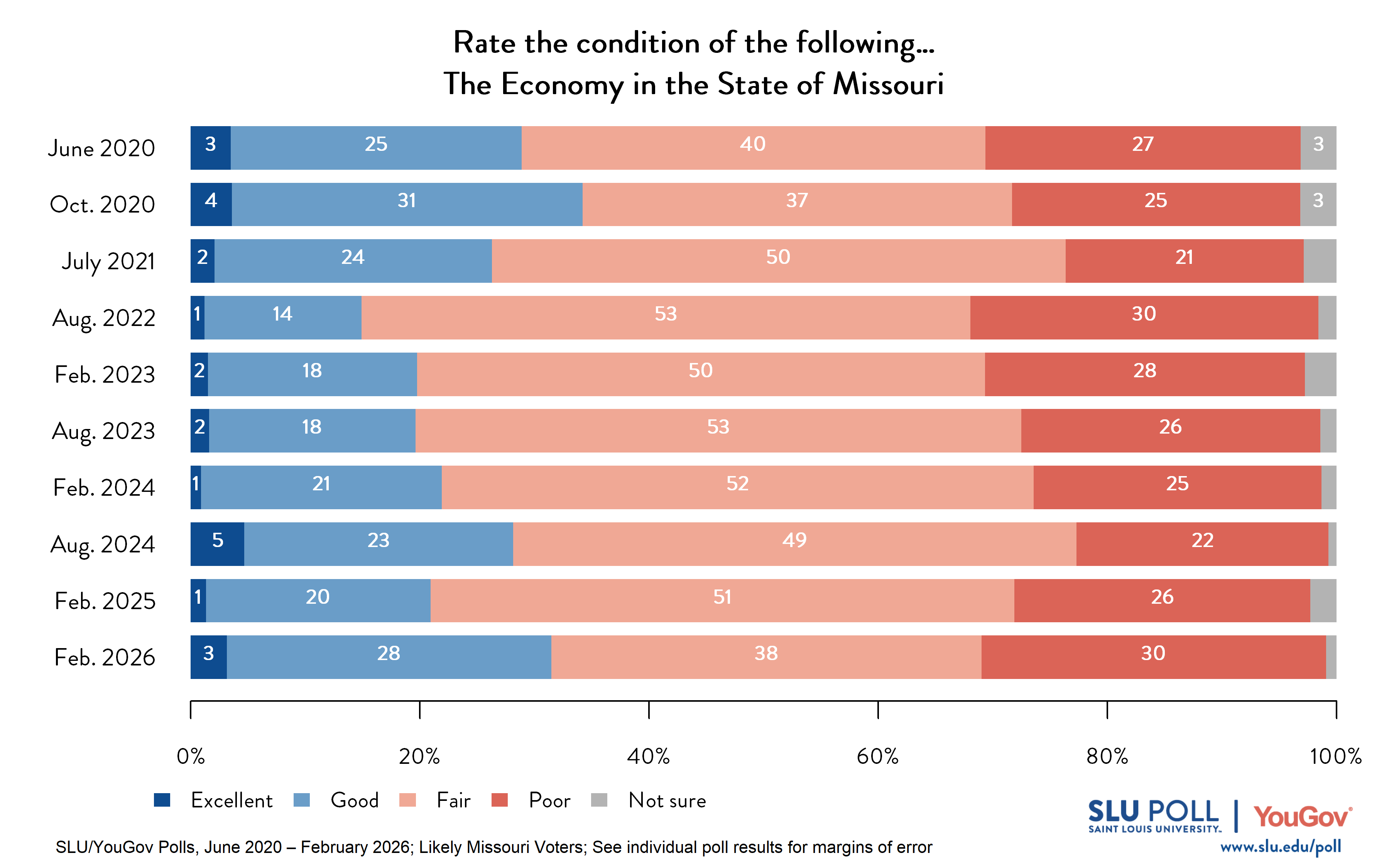 Likely voters' responses to 'How would you rate the following...The Economy in the
State of Missouri?'. June 2020 Voter Responses 3% Excellent, 25% Good, 40% Fair, 27%
Poor, and 3% Not Sure. October 2020 Voter Responses: 4% Excellent, 31% Good, 37% Fair,
25% Poor, and 3% Not sure. July 2021 Voter Responses: 2% Excellent, 24% Good, 50%
Fair, 21% Poor, and 3% Not sure. August 2022 Voter Responses: 1% Excellent, 14% Good,
53% Fair, 30% Poor, and 2% Not sure. February 2023 Voter Responses: 2% Excellent,
18% Good, 50% Fair, 28% Poor, and 3% Not sure. August 2023 Voter Responses: 2% Excellent,
18% Good, 53% Fair, 26% Poor, and 1% Not sure. February 2024 Voter Responses: 1% Excellent,
21% Good, 52% Fair, 25% Poor, and 1% Not sure. August 2024 Voter Responses: 5% Excellent,
23% Good, 49% Fair, 22% Poor, and 1% Not sure. February 2025 Voter Responses: 1% Excellent,
20% Good, 51% Fair, 26% Poor, and 2% Not sure. February 2026 Voter Responses: 3% Excellent,
28% Good, 38% Fair, 30% Poor, and 1% Not sure.
Likely voters' responses to 'How would you rate the following...The Economy in the
State of Missouri?'. June 2020 Voter Responses 3% Excellent, 25% Good, 40% Fair, 27%
Poor, and 3% Not Sure. October 2020 Voter Responses: 4% Excellent, 31% Good, 37% Fair,
25% Poor, and 3% Not sure. July 2021 Voter Responses: 2% Excellent, 24% Good, 50%
Fair, 21% Poor, and 3% Not sure. August 2022 Voter Responses: 1% Excellent, 14% Good,
53% Fair, 30% Poor, and 2% Not sure. February 2023 Voter Responses: 2% Excellent,
18% Good, 50% Fair, 28% Poor, and 3% Not sure. August 2023 Voter Responses: 2% Excellent,
18% Good, 53% Fair, 26% Poor, and 1% Not sure. February 2024 Voter Responses: 1% Excellent,
21% Good, 52% Fair, 25% Poor, and 1% Not sure. August 2024 Voter Responses: 5% Excellent,
23% Good, 49% Fair, 22% Poor, and 1% Not sure. February 2025 Voter Responses: 1% Excellent,
20% Good, 51% Fair, 26% Poor, and 2% Not sure. February 2026 Voter Responses: 3% Excellent,
28% Good, 38% Fair, 30% Poor, and 1% Not sure.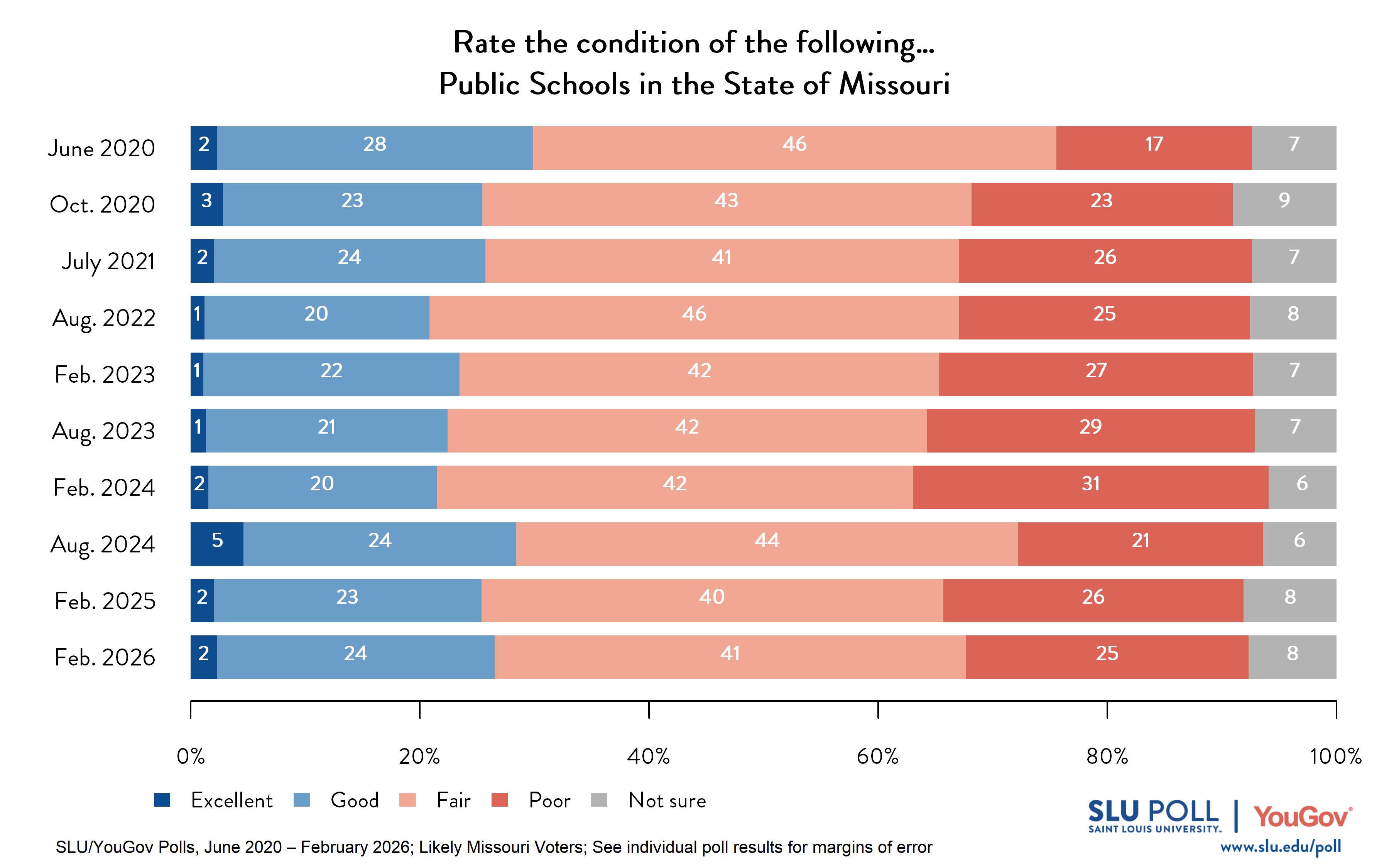 Likely voters' responses to 'How would you rate the following...Public Schools in
the State of Missouri?'. June 2020 Voter Responses 2% Excellent, 28% Good, 46% Fair,
17% Poor, and 7% Not Sure. October 2020 Voter Responses: 3% Excellent, 23% Good, 43%
Fair, 23% Poor, and 9% Not sure. July 2021 Voter Responses: 2% Excellent, 24% Good,
41% Fair, 26% Poor, and 7% Not sure. August 2022 Voter Responses: 1% Excellent, 20%
Good, 46% Fair, 25% Poor, and 8% Not sure. February 2023 Voter Responses: 1% Excellent,
22% Good, 42% Fair, 27% Poor, and 7% Not sure. August 2023 Voter Responses: 1% Excellent,
21% Good, 42% Fair, 29% Poor, and 7% Not sure. February 2024 Voter Responses: 2% Excellent,
20% Good, 42% Fair, 31% Poor, and 6% Not sure. August 2024 Voter Responses: 5% Excellent,
24% Good, 44% Fair, 21% Poor, and 6% Not sure. February 2025 Voter Responses: 2% Excellent,
23% Good, 40% Fair, 26% Poor, and 8% Not sure. February 2026 Voter Responses: 2% Excellent,
24% Good, 41% Fair, 25% Poor, and 8% Not sure.
Likely voters' responses to 'How would you rate the following...Public Schools in
the State of Missouri?'. June 2020 Voter Responses 2% Excellent, 28% Good, 46% Fair,
17% Poor, and 7% Not Sure. October 2020 Voter Responses: 3% Excellent, 23% Good, 43%
Fair, 23% Poor, and 9% Not sure. July 2021 Voter Responses: 2% Excellent, 24% Good,
41% Fair, 26% Poor, and 7% Not sure. August 2022 Voter Responses: 1% Excellent, 20%
Good, 46% Fair, 25% Poor, and 8% Not sure. February 2023 Voter Responses: 1% Excellent,
22% Good, 42% Fair, 27% Poor, and 7% Not sure. August 2023 Voter Responses: 1% Excellent,
21% Good, 42% Fair, 29% Poor, and 7% Not sure. February 2024 Voter Responses: 2% Excellent,
20% Good, 42% Fair, 31% Poor, and 6% Not sure. August 2024 Voter Responses: 5% Excellent,
24% Good, 44% Fair, 21% Poor, and 6% Not sure. February 2025 Voter Responses: 2% Excellent,
23% Good, 40% Fair, 26% Poor, and 8% Not sure. February 2026 Voter Responses: 2% Excellent,
24% Good, 41% Fair, 25% Poor, and 8% Not sure.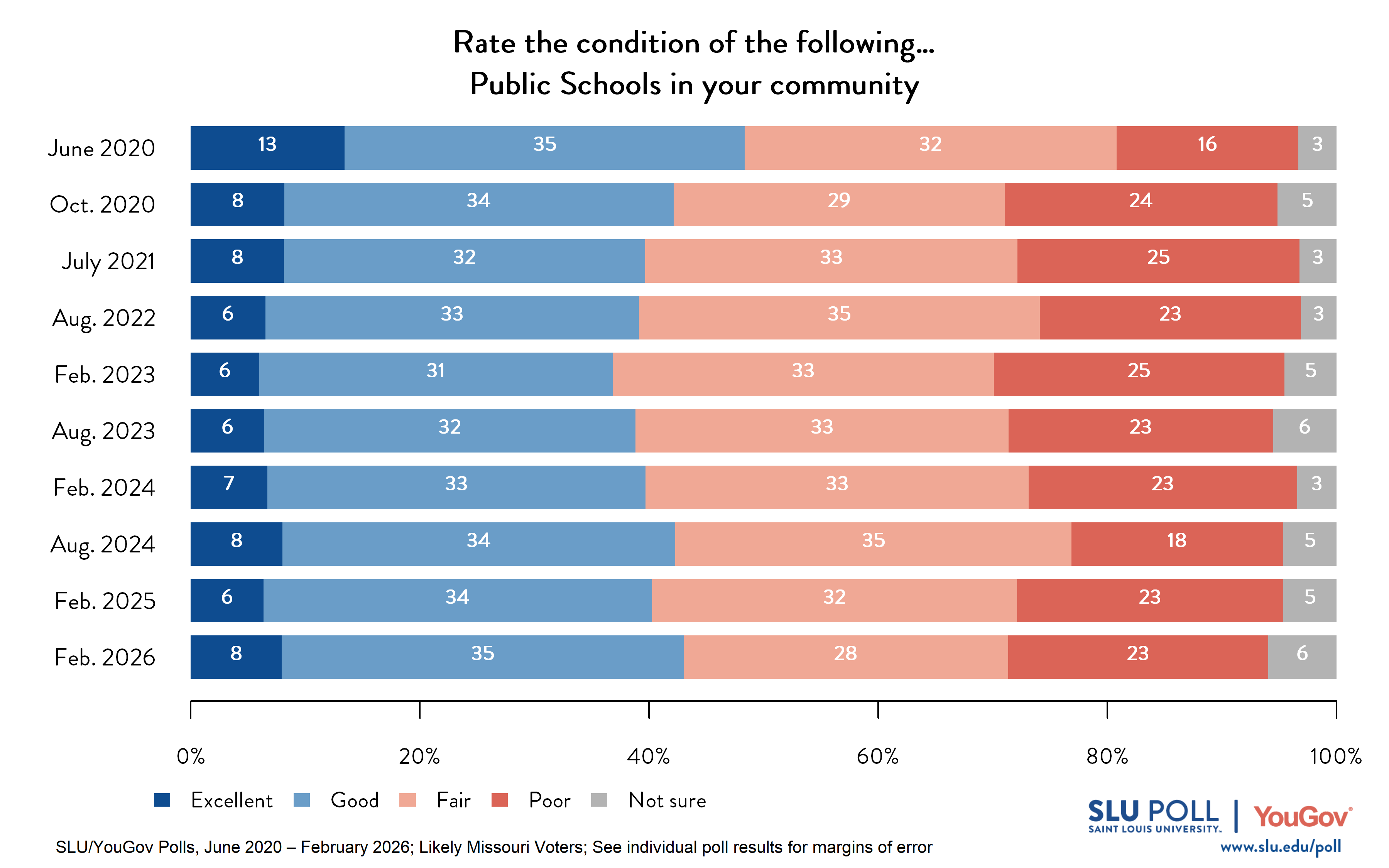 Likely voters' responses to 'How would you rate the following...Public Schools in
your community?'. June 2020 Voter Responses 13% Excellent, 35% Good, 32% Fair, 16%
Poor, and 3% Not Sure. October 2020 Voter Responses: 8% Excellent, 34% Good, 29% Fair,
24% Poor, and 5% Not sure. July 2021 Voter Responses: 8% Excellent, 32% Good, 33%
Fair, 25% Poor, and 3% Not sure. August 2022 Voter Responses: 6% Excellent, 33% Good,
35% Fair, 23% Poor, and 3% Not sure. February 2023 Voter Responses: 6% Excellent,
31% Good, 33% Fair, 25% Poor, and 5% Not sure. August 2023 Voter Responses: 6% Excellent,
32% Good, 33% Fair, 23% Poor, and 6% Not sure. February 2024 Voter Responses: 7% Excellent,
33% Good, 33% Fair, 23% Poor, and 3% Not sure. August 2024 Voter Responses: 8% Excellent,
34% Good, 35% Fair, 18% Poor, and 5% Not sure. February 2025 Voter Responses: 6% Excellent,
34% Good, 32% Fair, 23% Poor, and 5% Not sure. February 2026 Voter Responses: 8% Excellent,
35% Good, 28% Fair, 23% Poor, and 6% Not sure.
Likely voters' responses to 'How would you rate the following...Public Schools in
your community?'. June 2020 Voter Responses 13% Excellent, 35% Good, 32% Fair, 16%
Poor, and 3% Not Sure. October 2020 Voter Responses: 8% Excellent, 34% Good, 29% Fair,
24% Poor, and 5% Not sure. July 2021 Voter Responses: 8% Excellent, 32% Good, 33%
Fair, 25% Poor, and 3% Not sure. August 2022 Voter Responses: 6% Excellent, 33% Good,
35% Fair, 23% Poor, and 3% Not sure. February 2023 Voter Responses: 6% Excellent,
31% Good, 33% Fair, 25% Poor, and 5% Not sure. August 2023 Voter Responses: 6% Excellent,
32% Good, 33% Fair, 23% Poor, and 6% Not sure. February 2024 Voter Responses: 7% Excellent,
33% Good, 33% Fair, 23% Poor, and 3% Not sure. August 2024 Voter Responses: 8% Excellent,
34% Good, 35% Fair, 18% Poor, and 5% Not sure. February 2025 Voter Responses: 6% Excellent,
34% Good, 32% Fair, 23% Poor, and 5% Not sure. February 2026 Voter Responses: 8% Excellent,
35% Good, 28% Fair, 23% Poor, and 6% Not sure.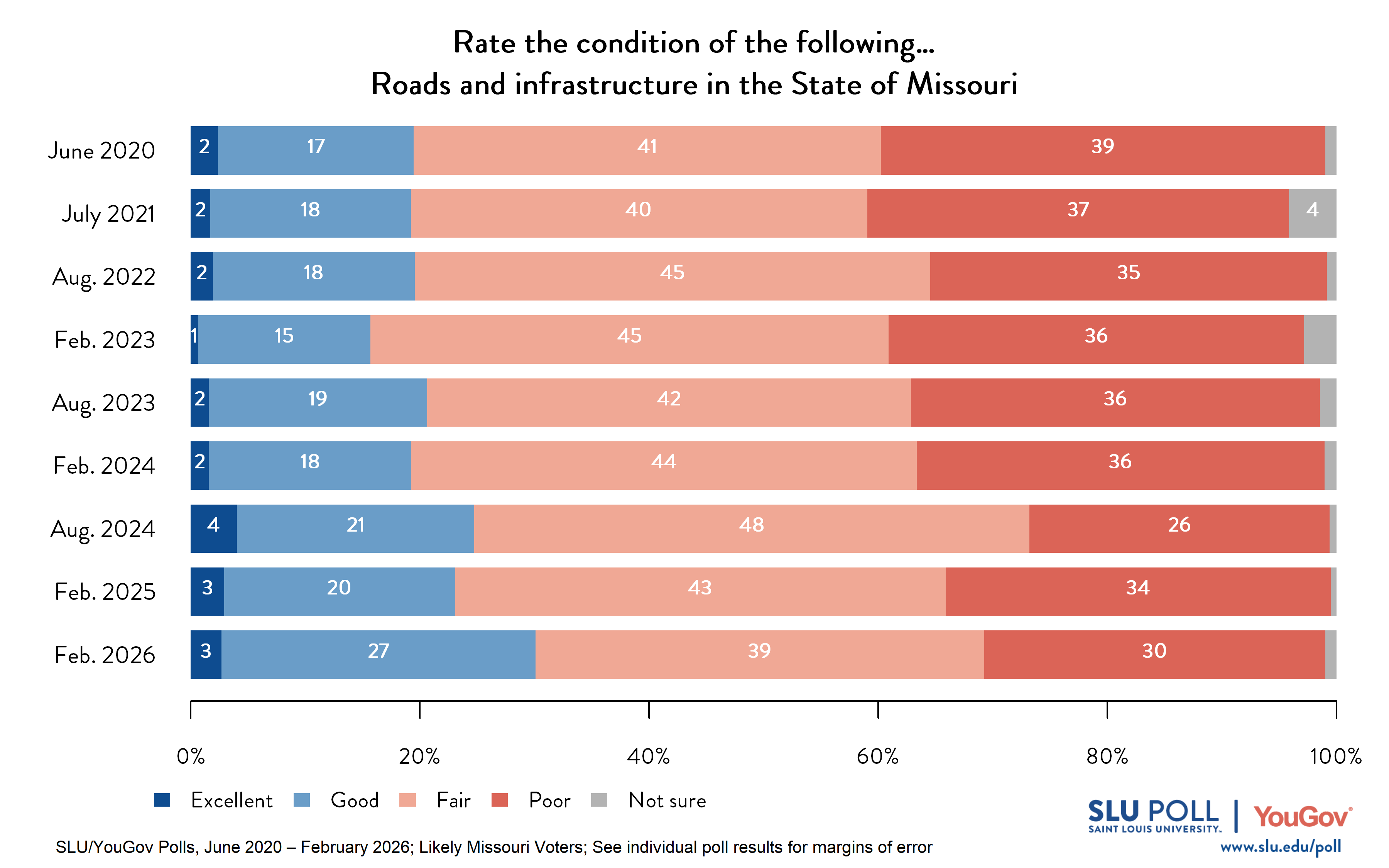 Likely voters' responses to 'How would you rate the following...Roads and infrastructure
in the State of Missouri?'. June 2020 Voter Responses 2% Excellent, 17% Good, 41%
Fair, 39% Poor, and 1% Not Sure. July 2021 Voter Responses: 2% Excellent, 18% Good,
40% Fair, 37% Poor, and 4% Not sure. August 2022 Voter Responses: 2% Excellent, 18%
Good, 45% Fair, 35% Poor, and 1% Not sure. February 2023 Voter Responses: 1% Excellent,
15% Good, 45% Fair, 36% Poor, and 3% Not sure. August 2023 Voter Responses: 2% Excellent,
19% Good, 42% Fair, 36% Poor, and 1% Not sure. February 2024 Voter Responses: 2% Excellent,
18% Good, 44% Fair, 36% Poor, and 1% Not sure. August 2024 Voter Responses: 4% Excellent,
21% Good, 48% Fair, 26% Poor, and 1% Not sure. February 2025 Voter Responses: 3% Excellent,
20% Good, 43% Fair, 34% Poor, and 1% Not sure. February 2026 Voter Responses: 3% Excellent,
27% Good, 39% Fair, 30% Poor, and 1% Not sure.
Likely voters' responses to 'How would you rate the following...Roads and infrastructure
in the State of Missouri?'. June 2020 Voter Responses 2% Excellent, 17% Good, 41%
Fair, 39% Poor, and 1% Not Sure. July 2021 Voter Responses: 2% Excellent, 18% Good,
40% Fair, 37% Poor, and 4% Not sure. August 2022 Voter Responses: 2% Excellent, 18%
Good, 45% Fair, 35% Poor, and 1% Not sure. February 2023 Voter Responses: 1% Excellent,
15% Good, 45% Fair, 36% Poor, and 3% Not sure. August 2023 Voter Responses: 2% Excellent,
19% Good, 42% Fair, 36% Poor, and 1% Not sure. February 2024 Voter Responses: 2% Excellent,
18% Good, 44% Fair, 36% Poor, and 1% Not sure. August 2024 Voter Responses: 4% Excellent,
21% Good, 48% Fair, 26% Poor, and 1% Not sure. February 2025 Voter Responses: 3% Excellent,
20% Good, 43% Fair, 34% Poor, and 1% Not sure. February 2026 Voter Responses: 3% Excellent,
27% Good, 39% Fair, 30% Poor, and 1% Not sure.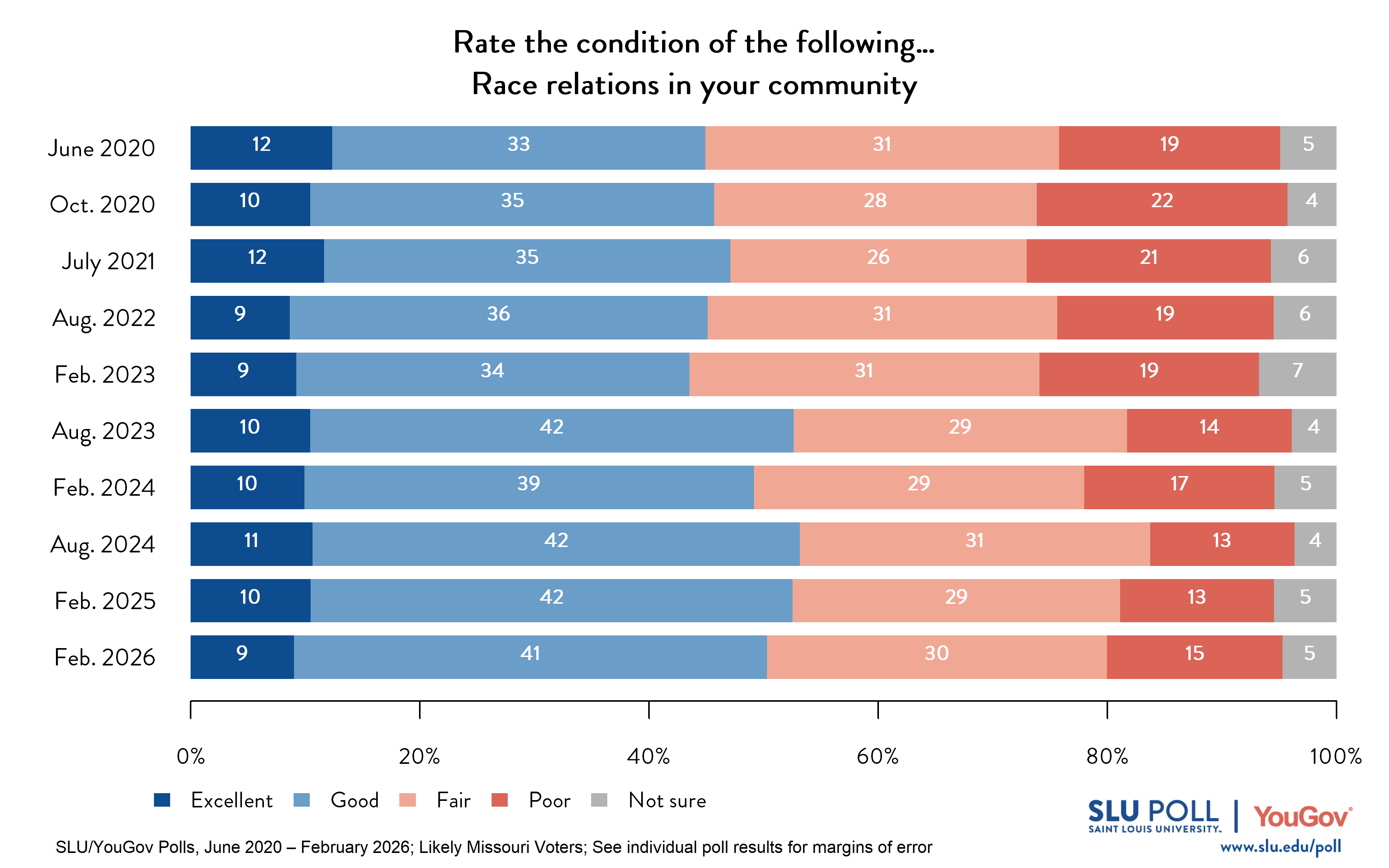 Likely voters' responses to 'How would you rate the following...Race relations in
your community?'. June 2020 Voter Responses 12% Excellent, 33% Good, 31% Fair, 19%
Poor, and 5% Not Sure. October 2020 Voter Responses: 10% Excellent, 35% Good, 28%
Fair, 22% Poor, and 4% Not sure. July 2021 Voter Responses: 12% Excellent, 35% Good,
26% Fair, 21% Poor, and 6% Not sure. August 2022 Voter Responses: 9% Excellent, 36%
Good, 31% Fair, 19% Poor, and 6% Not sure. February 2023 Voter Responses: 9% Excellent,
34% Good, 31% Fair, 19% Poor, and 7% Not sure. August 2023 Voter Responses: 10% Excellent,
42% Good, 29% Fair, 14% Poor, and 4% Not sure. February 2024 Voter Responses: 8% Excellent,
31% Good, 30% Fair, 29% Poor, and 2% Not sure. August 2024 Voter Responses: 8% Excellent,
34% Good, 36% Fair, 17% Poor, and 4% Not sure. February 2025 Voter Responses: 8% Excellent,
36% Good, 32% Fair, 21% Poor, and 3% Not sure. February 2026 Voter Responses: 12%
Excellent, 34% Good, 31% Fair, 21% Poor, and 2% Not sure.
Likely voters' responses to 'How would you rate the following...Race relations in
your community?'. June 2020 Voter Responses 12% Excellent, 33% Good, 31% Fair, 19%
Poor, and 5% Not Sure. October 2020 Voter Responses: 10% Excellent, 35% Good, 28%
Fair, 22% Poor, and 4% Not sure. July 2021 Voter Responses: 12% Excellent, 35% Good,
26% Fair, 21% Poor, and 6% Not sure. August 2022 Voter Responses: 9% Excellent, 36%
Good, 31% Fair, 19% Poor, and 6% Not sure. February 2023 Voter Responses: 9% Excellent,
34% Good, 31% Fair, 19% Poor, and 7% Not sure. August 2023 Voter Responses: 10% Excellent,
42% Good, 29% Fair, 14% Poor, and 4% Not sure. February 2024 Voter Responses: 8% Excellent,
31% Good, 30% Fair, 29% Poor, and 2% Not sure. August 2024 Voter Responses: 8% Excellent,
34% Good, 36% Fair, 17% Poor, and 4% Not sure. February 2025 Voter Responses: 8% Excellent,
36% Good, 32% Fair, 21% Poor, and 3% Not sure. February 2026 Voter Responses: 12%
Excellent, 34% Good, 31% Fair, 21% Poor, and 2% Not sure.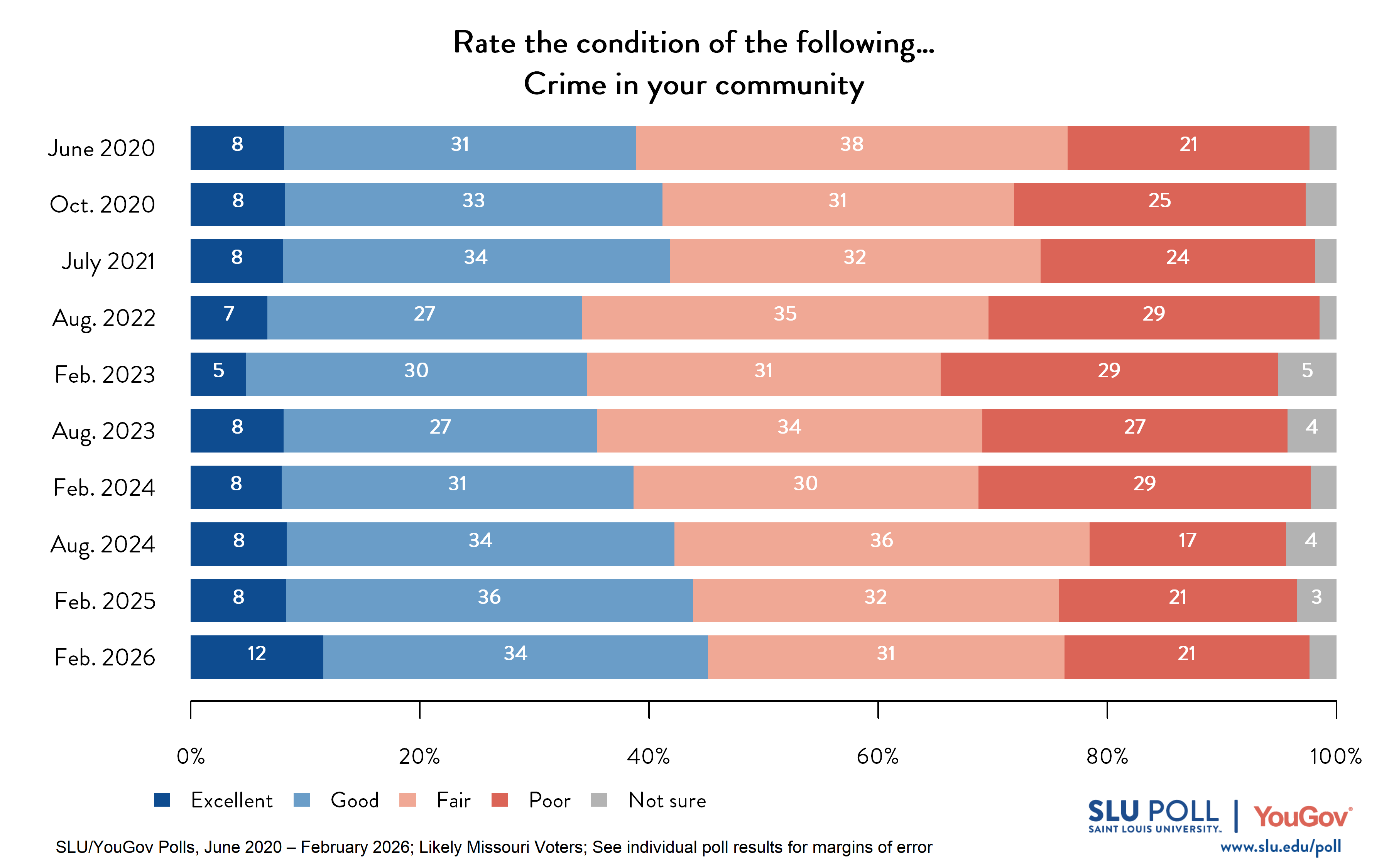 Likely voters' responses to 'How would you rate the following...Crime in your community?'.
June 2020 Voter Responses 8% Excellent, 31% Good, 38% Fair, 21% Poor, and 2% Not Sure.
October 2020 Voter Responses: 8% Excellent, 33% Good, 31% Fair, 25% Poor, and 3% Not
sure. July 2021 Voter Responses: 8% Excellent, 34% Good, 32% Fair, 24% Poor, and 2%
Not sure. August 2022 Voter Responses: 7% Excellent, 27% Good, 35% Fair, 29% Poor,
and 2% Not sure. February 2023 Voter Responses: 5% Excellent, 30% Good, 31% Fair,
29% Poor, and 5% Not sure. August 2023 Voter Responses: 8% Excellent, 27% Good, 34%
Fair, 27% Poor, and 4% Not sure. February 2024 Voter Responses: 8% Excellent, 31%
Good, 30% Fair, 29% Poor, and 2% Not sure. August 2024 Voter Responses: 8% Excellent,
34% Good, 36% Fair, 17% Poor, and 4% Not sure. February 2025 Voter Responses: 8% Excellent,
36% Good, 32% Fair, 21% Poor, and 3% Not sure. February 2026 Voter Responses: 12%
Excellent, 34% Good, 31% Fair, 21% Poor, and 2% Not sure.
Likely voters' responses to 'How would you rate the following...Crime in your community?'.
June 2020 Voter Responses 8% Excellent, 31% Good, 38% Fair, 21% Poor, and 2% Not Sure.
October 2020 Voter Responses: 8% Excellent, 33% Good, 31% Fair, 25% Poor, and 3% Not
sure. July 2021 Voter Responses: 8% Excellent, 34% Good, 32% Fair, 24% Poor, and 2%
Not sure. August 2022 Voter Responses: 7% Excellent, 27% Good, 35% Fair, 29% Poor,
and 2% Not sure. February 2023 Voter Responses: 5% Excellent, 30% Good, 31% Fair,
29% Poor, and 5% Not sure. August 2023 Voter Responses: 8% Excellent, 27% Good, 34%
Fair, 27% Poor, and 4% Not sure. February 2024 Voter Responses: 8% Excellent, 31%
Good, 30% Fair, 29% Poor, and 2% Not sure. August 2024 Voter Responses: 8% Excellent,
34% Good, 36% Fair, 17% Poor, and 4% Not sure. February 2025 Voter Responses: 8% Excellent,
36% Good, 32% Fair, 21% Poor, and 3% Not sure. February 2026 Voter Responses: 12%
Excellent, 34% Good, 31% Fair, 21% Poor, and 2% Not sure.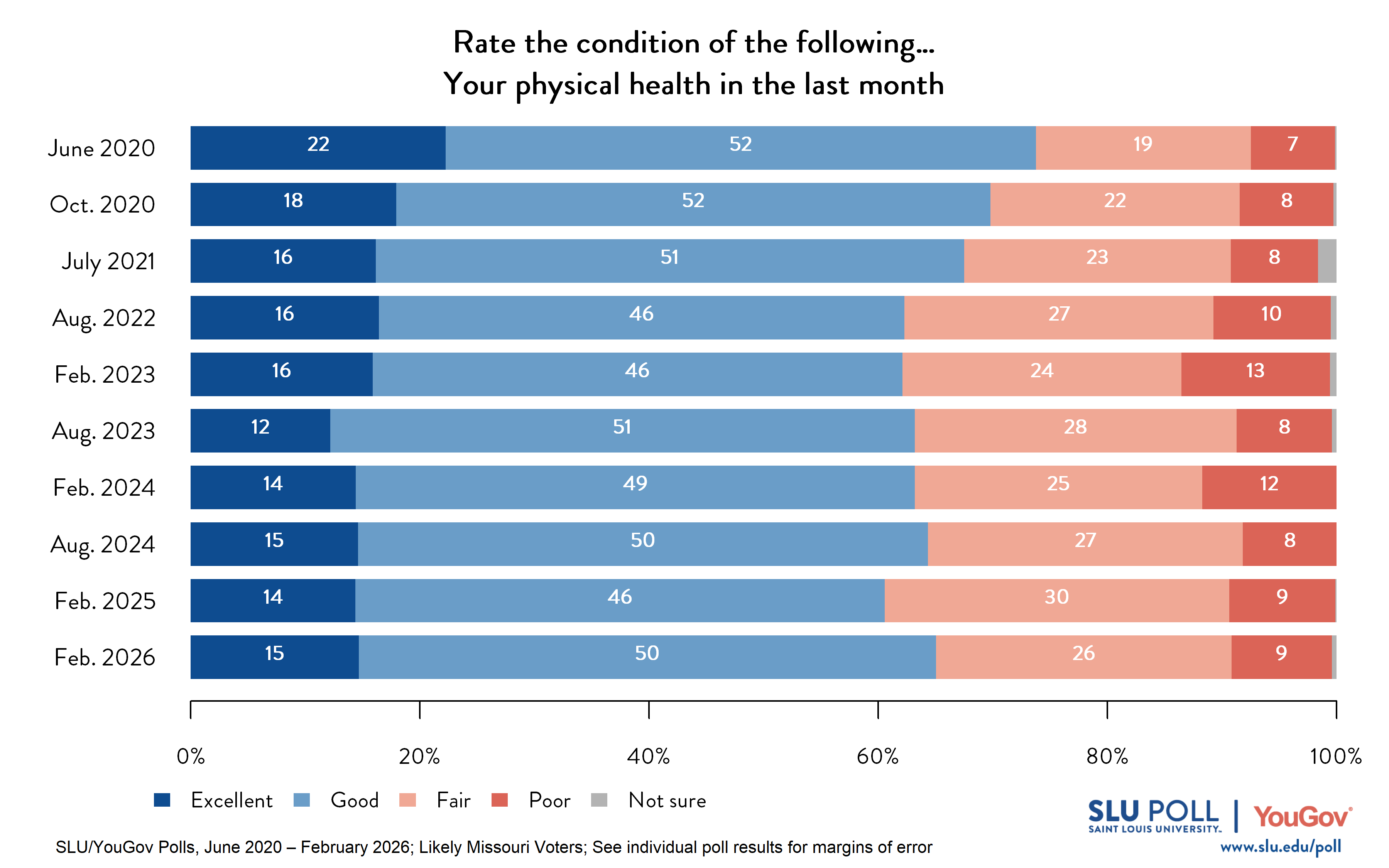 Likely voters' responses to 'How would you rate the following...Your physical health
in the last month?'. June 2020 Voter Responses 22% Excellent, 52% Good, 19% Fair,
7% Poor, and 0% Not sure. October 2020 Voter Responses: 18% Excellent, 52% Good, 22%
Fair, 8% Poor, and 0% Not sure. July 2021 Voter Responses: 16% Excellent, 51% Good,
23% Fair, 8% Poor, and 2% Not sure. August 2022 Voter Responses: 16% Excellent, 46%
Good, 27% Fair, 10% Poor, and 1% Not sure. February 2023 Voter Responses: 16% Excellent,
46% Good, 24% Fair, 13% Poor, and 1% Not sure. August 2023 Voter Responses: 12% Excellent,
51% Good, 28% Fair, 8% Poor, and 0% Not sure. February 2024 Voter Responses: 14% Excellent,
49% Good, 25% Fair, 12% Poor, and 0% Not sure. August 2024 Voter Responses: 15% Excellent,
50% Good, 27% Fair, 8% Poor, and 0% Not sure. February 2025 Voter Responses: 14% Excellent,
46% Good, 30% Fair, 9% Poor, and 0% Not sure. February 2026 Voter Responses: 15% Excellent,
50% Good, 26% Fair, 9% Poor, and 0% Not sure.
Likely voters' responses to 'How would you rate the following...Your physical health
in the last month?'. June 2020 Voter Responses 22% Excellent, 52% Good, 19% Fair,
7% Poor, and 0% Not sure. October 2020 Voter Responses: 18% Excellent, 52% Good, 22%
Fair, 8% Poor, and 0% Not sure. July 2021 Voter Responses: 16% Excellent, 51% Good,
23% Fair, 8% Poor, and 2% Not sure. August 2022 Voter Responses: 16% Excellent, 46%
Good, 27% Fair, 10% Poor, and 1% Not sure. February 2023 Voter Responses: 16% Excellent,
46% Good, 24% Fair, 13% Poor, and 1% Not sure. August 2023 Voter Responses: 12% Excellent,
51% Good, 28% Fair, 8% Poor, and 0% Not sure. February 2024 Voter Responses: 14% Excellent,
49% Good, 25% Fair, 12% Poor, and 0% Not sure. August 2024 Voter Responses: 15% Excellent,
50% Good, 27% Fair, 8% Poor, and 0% Not sure. February 2025 Voter Responses: 14% Excellent,
46% Good, 30% Fair, 9% Poor, and 0% Not sure. February 2026 Voter Responses: 15% Excellent,
50% Good, 26% Fair, 9% Poor, and 0% Not sure.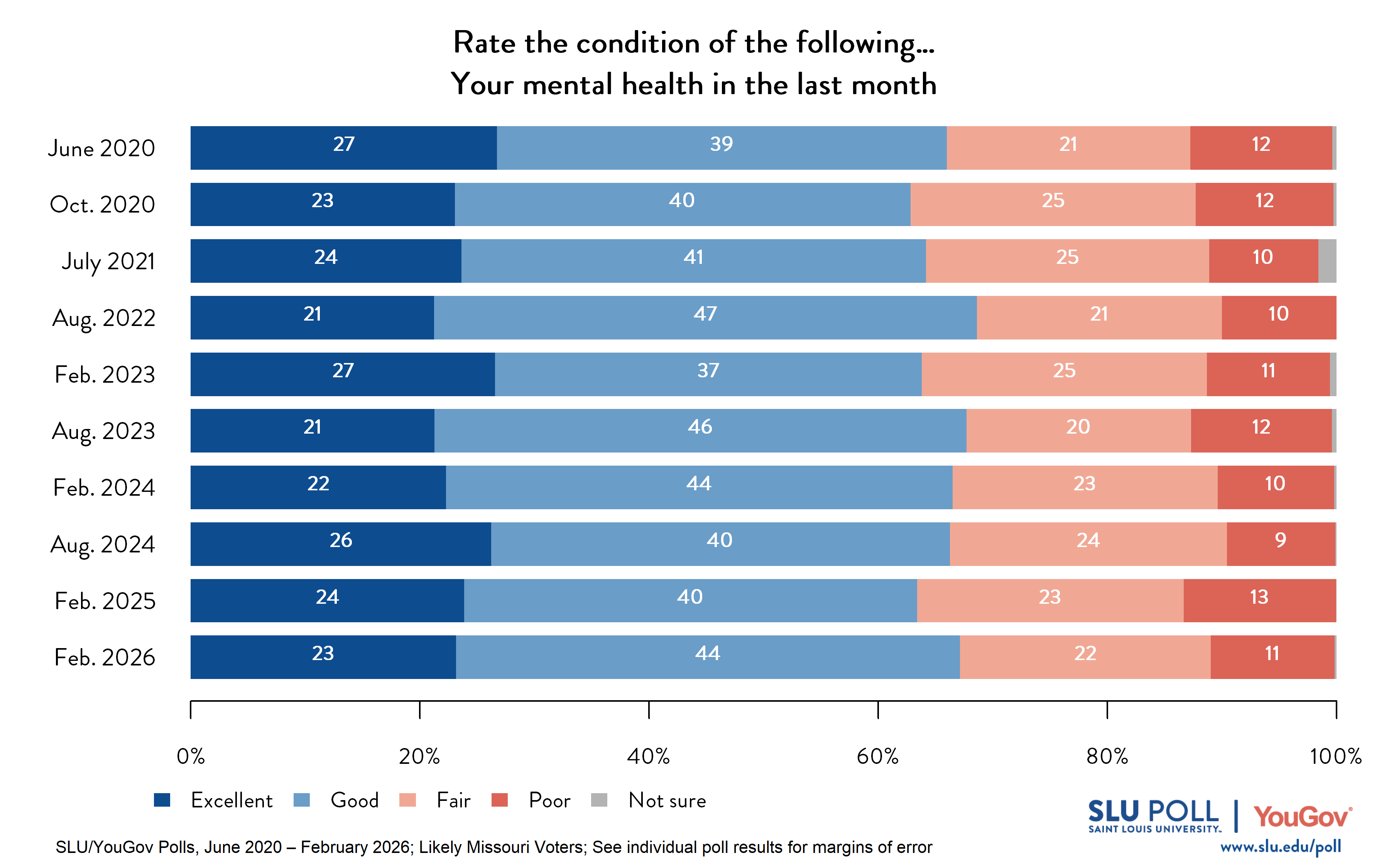 Likely voters' responses to 'How would you rate the following...Your mental health
in the last month?'. June 2020 Voter Responses 27% Excellent, 39% Good, 21% Fair,
12% Poor, and 0% Not sure. October 2020 Voter Responses: 23% Excellent, 40% Good,
25% Fair, 12% Poor, and 0% Not sure. July 2021 Voter Responses: 24% Excellent, 41%
Good, 25% Fair, 10% Poor, and 2% Not sure. August 2022 Voter Responses: 21% Excellent,
47% Good, 21% Fair, 10% Poor, and 0% Not sure. February 2023 Voter Responses: 27%
Excellent, 37% Good, 25% Fair, 11% Poor, and 1% Not sure. August 2023 Voter Responses:
21% Excellent, 46% Good, 20% Fair, 12% Poor, and 0% Not sure. February 2024 Voter
Responses: 22% Excellent, 44% Good, 23% Fair, 10% Poor, and 0% Not sure. August 2024
Voter Responses: 26% Excellent, 40% Good, 24% Fair, 9% Poor, and 0% Not sure. February
2025 Voter Responses: 24% Excellent, 40% Good, 23% Fair, 13% Poor, and 0% Not sure.
February 2026 Voter Responses: 23% Excellent, 44% Good, 22% Fair, 11% Poor, and 0%
Not sure.
Likely voters' responses to 'How would you rate the following...Your mental health
in the last month?'. June 2020 Voter Responses 27% Excellent, 39% Good, 21% Fair,
12% Poor, and 0% Not sure. October 2020 Voter Responses: 23% Excellent, 40% Good,
25% Fair, 12% Poor, and 0% Not sure. July 2021 Voter Responses: 24% Excellent, 41%
Good, 25% Fair, 10% Poor, and 2% Not sure. August 2022 Voter Responses: 21% Excellent,
47% Good, 21% Fair, 10% Poor, and 0% Not sure. February 2023 Voter Responses: 27%
Excellent, 37% Good, 25% Fair, 11% Poor, and 1% Not sure. August 2023 Voter Responses:
21% Excellent, 46% Good, 20% Fair, 12% Poor, and 0% Not sure. February 2024 Voter
Responses: 22% Excellent, 44% Good, 23% Fair, 10% Poor, and 0% Not sure. August 2024
Voter Responses: 26% Excellent, 40% Good, 24% Fair, 9% Poor, and 0% Not sure. February
2025 Voter Responses: 24% Excellent, 40% Good, 23% Fair, 13% Poor, and 0% Not sure.
February 2026 Voter Responses: 23% Excellent, 44% Good, 22% Fair, 11% Poor, and 0%
Not sure.About the SLU/YouGov Poll
The SLU/YouGov Poll fills a void in the study of public opinion in Missouri. No other academic institution regularly conducts a non-partisan, scientific survey of Missouri voters and publicly makes its results available to citizens, researchers and policymakers. The SLU/YouGov Poll aligns with SLU's Jesuit mission to pursue Truth for the common good. It also contributes to the mission of “faith that does justice” by informing SLU’s surrounding communities to improve solidarity within those communities. The SLU You/Gov Poll, for example, regularly asks Missourians for their opinion on government spending for the poor, race relations in their communities, views on education and law enforcement.
Poll Director Steven Rogers, Ph.D., associate professor of political science, leads a team of experts in survey research and policymaking. The associate director of the SLU/YouGov Poll is Kenneth Warren, Ph.D., professor of political science, who has more than 30 years of professional polling experience.
SLU has partnered with YouGov to conduct its annual survey of Missourians. YouGov conducts surveys for multiple academic institutions and is the primary trusted survey firm for media organizations including CBS News and The Economist. An independent Pew Research Center study of online survey firms in 2016 further concluded YouGov “consistently outperforms competitors.”
The origins of the SLU/YouGov Poll lie in an internal Big Ideas competition to define university-wide strategic research priorities sponsored by the SLU Research Institute. The Big Ideas competition provides funding to research initiatives that demonstrate broad faculty engagement, strong leadership and compelling research plans.
For questions or suggestions for the SLU/YouGov Poll, contact SLU Poll Director Steven Rogers, Ph.D., at [email protected].